

Can AI Reduce Trading Emotions? Benefits and Limits
AI can monitor trading setups, reduce repetitive decisions, and reveal execution mistakes—but it cannot eliminate emotions or guarantee profits. Learn where decision support helps and why hard risk controls matter.
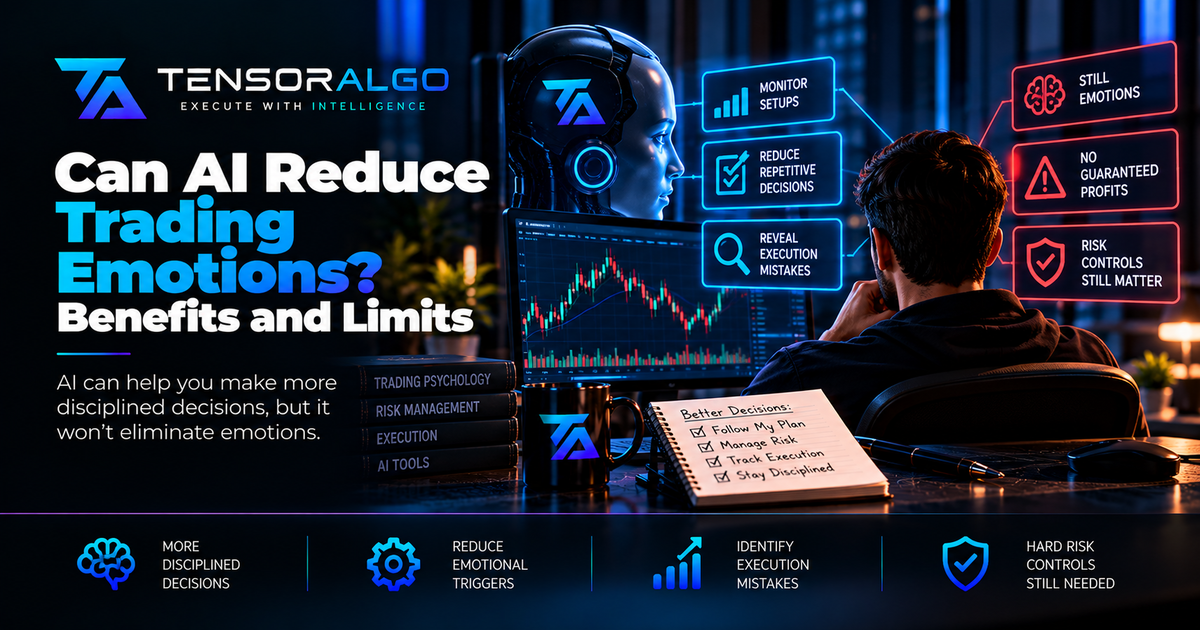
Can AI Reduce Trading Emotions? Benefits and Limits
AI-assisted trading tools can make a complicated trading workflow more structured. They can watch defined setups, organize evidence, flag missing information and help review decisions. But the idea that an AI assistant simply "removes trading emotions" is misleading.
Fear, frustration and excitement do not disappear because software is available. Traders can ignore alerts, override the rules, follow inaccurate analysis or increase risk after a winning streak. A bot can also introduce entirely different mistakes.
The useful question is narrower: which impulsive decisions can be replaced by predefined, verifiable steps, and which choices still require human judgment? That question leads to a more realistic trading workflow than promising emotion-free execution.
The Distinction Between Feelings and Rule Violations
Emotion is internal; behavior can be observed. A trader may feel nervous but still enter a valid setup with correct size and stop. Another trader may feel confident while entering an unplanned trade.
Judge execution primarily against the written plan rather than trying to infer whether the trader was calm. Useful categories include early entry, late entry, excessive size, unapproved stop movement, missed setup, duplicate entry and correct no-trade decision.
An AI tool can help organize these categories when it has trustworthy timestamps and rule definitions. It cannot establish that a trader felt fear from a red candle alone. That distinction helps prevent vague psychology language from replacing useful measurement.
Start With a Plan Before Adding AI
Good software cannot compensate for a strategy that changes every time price moves. Write down the eligible market, session, context filters, trigger, invalidation, exit logic, position-size rules and maximum daily exposure.
The CME trade-plan course covers objectives, methodology, risk management, strategies and trade logging. This structure is useful even if no model is involved.
When the rules are explicit, technology can check whether conditions align or a decision departed from the plan. Without rules, an assistant may produce helpful-sounding commentary without any measurable standard for correctness.
Start with a small, clear rule-based trading system. Add an assistant only after you can describe what it is supposed to monitor.
AI Monitoring Can Reduce Manual Scanning
Following NQ, ES, and other instruments while watching order flow and session levels demands attention. A trader may miss a setup because of chart switching rather than because the strategy is defective.
Software can compare incoming observations against specified conditions and bring relevant candidates to attention. This may improve visibility, but it does not mean every alert will be timely or valid.
Check instrument identity, contract rollover, event timestamps, feed availability and any alert cooldowns. A signal for the wrong contract or from delayed input can be worse than no signal. Label expired opportunities as expired instead of pretending they remain immediately actionable.
Monitoring is an operational tool, not an independent proof of profitable predictive skill.
Turn FOMO Into a Defined Decision
A frequent source of bad entries is noticing a legitimate setup only after price has moved well beyond the intended entry zone.
If the Playbook defines when an opportunity expires, the decision is easier: the valid entry window either remains open or it does not. Without an expiration rule, every fast candle invites an improvised exception.
An assistant can display the planned zone, confirmation requirements, remaining reward relative to stop and conditions that would invalidate the idea. The trader can then choose not to chase rather than relying on willpower alone.
That process does not remove the disappointment of missing a trade. It turns the decision into something auditable rather than emotional guesswork.
The Importance of a True No-Trade State
Some tools appear to believe a good response must contain a LONG or SHORT idea. A trading strategy often requires neither. If volatility, structure or risk limits do not permit an entry, no trade is a legitimate outcome.
The same is true when data are missing, stale or contradictory. A model should not fill gaps with plausible figures merely to create a confident narrative.
The NIST AI Risk Management Framework emphasizes governance, measurement and management of AI risks over a system's lifecycle. In practical trading terms, define conditions under which the assistant must abstain, request fresh evidence or escalate a problem.
A system that can say "insufficient reliable information" is more useful than one that always sounds certain.
An Example: A Hypothetical VWAP Pullback
Imagine a setup requiring a defined directional context, price to revisit VWAP, a confirmation trigger, a stop beyond invalidation and sufficient distance to the next resistance level.
An assistant could report that the directional context is present but the confirmation is still missing. It could also note that the remaining target distance is too small after the market moves away from the intended zone.
The appropriate output might be "waiting for trigger" or "expired." Those categories are more actionable than an enthusiastic "strong bullish setup" that omits execution requirements.
This is an educational illustration, not a market recommendation. Even if all conditions qualify, the trade may lose. Rule compliance and market profitability are different questions.
Model Explanations Are Not Evidence by Themselves
A language model can explain the same chart from bullish and bearish perspectives, especially when a prompt asks it to defend one side. Fluent commentary is not equivalent to a calibrated prediction.
Require observable support: which market input, timestamp, indicator definition, source or strategy rule produced the statement? What counter-evidence would invalidate the conclusion? What is missing or uncertain?
When an assistant references GEX, for example, weekly exposures and 0DTE estimates have different scopes. When it references market price, an ETF proxy is not necessarily a live futures quote. Without source integrity, numerical-looking precision can mislead.
The practical standard is inspectable evidence, not impressive prose.
Deterministic Risk Controls Must Remain Independent
Some checks should not be negotiated inside a chat response. Maximum order size, permitted symbol, loss limits, duplicate-order protection, account identity and position reconciliation belong in independently enforced controls.
An AI assistant might explain why a limit exists or help surface an approaching boundary. It should not quietly override that boundary because it finds a setup attractive.
The CFTC's before-trading checklist reminds traders to assess their goals, financial capacity for loss and costs. These constraints remain relevant whether a decision is discretionary, rule-driven or AI-assisted.
Consider the practical failure case: a model suggests a trade while a broker shows an open position the model has not seen. The execution system must reconcile actual state before permitting another order.
An AI Assistant Is Not Necessarily a Trading Bot
An assistant may summarize, alert, classify and support review without placing orders. A trading bot generally has authority or programmed access to submit, modify or cancel orders.
These are distinct risk categories. Automated execution requires safeguards for network failures, order rejections, duplicate submission, price gaps, incorrect quantity, stale order state and shutdown behavior.
The Trading Automation Explained guide provides background. Do not treat several accurate AI summaries as proof that unattended trading will be safe.
If execution is ever enabled, the operational testing, permissions, and risk boundaries should be reviewed separately from the quality of the assistant's text.
AI Can Help Journal, but It Cannot Invent Fills
After a trading session, an assistant might summarize the planned setup, compare entry timing with the rule, identify stop deviations or list missed opportunities. This can reduce repetitive administrative work.
But the summary must respect source limitations. Seeing a candle touch a hypothetical entry or target does not establish that a broker filled the order. A copied trade command is not independent confirmation of execution. Costs require actual records or clearly labeled modeling.
Use a journal that separates intention, broker-confirmed activity, candidate observations, and unknowns. The Trading Journal Guide explains why this separation matters.
If the tool cannot validate a record, it should mark it unverified instead of producing a clean but false performance number.
The Risk of Over-Alerting
An assistant that floods the screen with opportunities may increase impulsive activity. Every notification can feel urgent, even when it is a duplicate, a weak near miss or a signal outside the risk plan.
Reduce noise by specifying exact qualification criteria, suppressing duplicates and distinguishing a market update from a genuinely new permitted trade.
Measure more than alert count. How many notifications corresponded to qualified setups? How many arrived while the entry was still valid? How many were false positives, stale or repeated? How many led to unplanned trades?
The purpose of monitoring is not to maximize engagement. It is to help the trader act only when the documented process allows.
Data Quality Is Part of Behavioral Safety
A delayed quote may make a profitable-looking entry appear available after the opportunity has passed. A mismatched London session profile or missing delta value can produce confident but inaccurate analysis.
Record the timestamp and source of each required input. Validate the instrument and session, and disclose when a calculation substitutes an estimate for a live observation. If conflicting providers use different definitions, explain the difference rather than averaging away the contradiction.
Any risk/reward distance built from the wrong price can be materially misleading. The correct response to an unreliable critical input is to pause or label the candidate unsuitable for action.
Better inputs and stricter failure behavior can prevent more operational mistakes than an elaborate trading prompt.
AI Can Expose Repeated Execution Mistakes
Suppose a journal shows a pattern: the trader follows risk rules early in a session but repeatedly chases entries after several consecutive losses.
An assistant could group those trade records, calculate the documented rule-violation frequency and surface representative examples. That can make a weak habit easier to see without claiming to diagnose the trader's psychology.
A useful report should separate planned and actual entry, pre-trade evidence, order fills, outcome and missing records. It should also avoid portraying a few cases as a universal law.
Use the insight to redesign one part of the workflow—for example, an explicit entry-expiration rule—then track whether adherence improves under similar conditions.
AI Cannot Create Positive Expectancy from Nothing
A strategy that has negative net expectancy under realistic costs remains problematic even with perfect alert delivery and meticulous trade journaling.
An assistant could reduce some execution errors; that is not the same as discovering a profitable signal. Testing strategy quality requires enough comparable decisions, realistic fees, liquidity and slippage assumptions, and attention to market-regime changes.
Backtests can be influenced by hindsight and overfitting. The NFA hypothetical-performance notice explains why simulated results cannot reproduce every live trading effect.
Do not accept a software marketing claim that AI guarantees a higher win rate. The appropriate evidence is reproducible and net of costs, with clear separation of hypothetical and verified outcomes.
A Practical Pilot Before You Depend on AI
Choose one operational problem: missed valid setups, late entries or incomplete trade reviews. First measure the baseline with your existing process.
Next, enable one AI-assisted monitoring or review function without automatic trading. Record alerts, timestamps, data problems, rule compliance and user overrides. Compare the results without assuming a favorable week proves a durable improvement.
Watch for negative effects. Are there more interruptions? Are alerts arriving too late? Is the assistant encouraging trades when conditions are absent? Is it hiding uncertainty behind confident wording?
A short pilot can establish usability, but not reliable future trading returns. Treat the findings as a reason to refine controls and data quality rather than as permission to scale risk.
How TensorAlgo Fits into the Workflow
TensorAlgo supports user-defined Playbooks, live monitoring and AI-assisted trading workflows. The useful starting point is to define the actual strategy conditions and let supported tools make those conditions easier to follow and review.
The first Playbook guide explains how to create your own Playbook. The public marketplace is for discovering, renting, or buying eligible Playbooks created by others; it is not where users create or manage their own Playbooks.
No trading assistant can promise to remove emotion, supply reliable price feeds at all times, prevent all user overrides or guarantee positive results. Product features and permissions should always be confirmed against the current Support documentation.
Use the assistant to support a plan you understand rather than outsourcing judgment to an opaque explanation.
Frequently Asked Questions
Will AI stop revenge trading?
Not by itself. It can make violations visible and support explicit limits, but a trader can still attempt to override the process. Account risk controls and self-management remain necessary.
Can AI alerts improve win rate?
Not reliably by default. Better setup visibility does not guarantee that the strategy has a positive net edge. Analyze the strategy and execution samples separately.
Should I let AI trade for me automatically?
Do not infer execution readiness from good analysis alone. Unattended trading introduces separate broker, technical and financial risks that require rigorous independent testing.
Can an assistant know why I was emotional?
Not from prices alone. It may help correlate observable behavior with events, but motivations and mental states should not be asserted as verified facts.
What is the most useful first AI feature?
Choose a capability that addresses a measurable problem, such as monitoring one rule-defined setup or organizing post-trade review, and validate its actual effectiveness.
A Practical Audit Checklist for the First Month
A productive evaluation records what the assistant promised to do and what it actually did. Begin with a written definition of valid inputs, eligible setups and explicit reasons for abstaining. If you cannot describe the expected behavior without watching market prices, the evaluation criteria may be too vague.
For every detected candidate, save the timestamp, market source, strategy version, qualifying conditions, alert time and eventual decision. Classify alerts as valid and timely, valid but late, repeated, false, or unverified because critical evidence was missing. Track what the user did next rather than assuming every alert became a trade.
When an alert becomes a trade, preserve planned risk, confirmed executions and estimated versus actual costs as different fields. Compare the records against the Risk Management Guide and preexisting account limits. A tool that frequently proposes excessive size or hides a missing stop is not ready for higher-impact use, regardless of how persuasive its market commentary sounds.
At the end of the month, discuss the operational measures separately from strategy expectancy. Did rule adherence improve? Were more eligible opportunities detected in time? Did the tool create distractions or encourage unnecessary activity? How many records could not be reconciled? Explicitly document each known failure.
Finally, decide whether the next iteration should improve alerts, data quality, journal structure or a strategy hypothesis. What Makes a Trading Strategy Profitable? explains why execution quality and positive expectancy must not be conflated. Better technology can help preserve the strategy as written, but the strategy's edge still needs independent evidence.
This checklist is an operational starting point, not a performance certification. Different markets, trading styles and user abilities can produce different results. A safe AI rollout uses measured progress, clear permissions and an easy way to turn off unreliable behavior.
Final Takeaway
AI may reduce avoidable manual friction in trading, but it does not make humans emotionless or make uncertain markets predictable.
The strongest design combines an explicit Playbook, reliable data, verifiable alerts, hard risk boundaries, careful outcome logging and the ability to decline uncertain decisions. Review whether the tool reduces specific mistakes without creating new ones.
A calm, structured process is a goal worth pursuing. A guarantee of emotion-free profitable execution is not.