

Copy Trading vs Learning Yourself
Copy trading can reduce decision load, while learning to trade builds independence. The better beginner path is usually to understand risk first, then use transparent rules and guided execution instead of blindly mirroring trades.
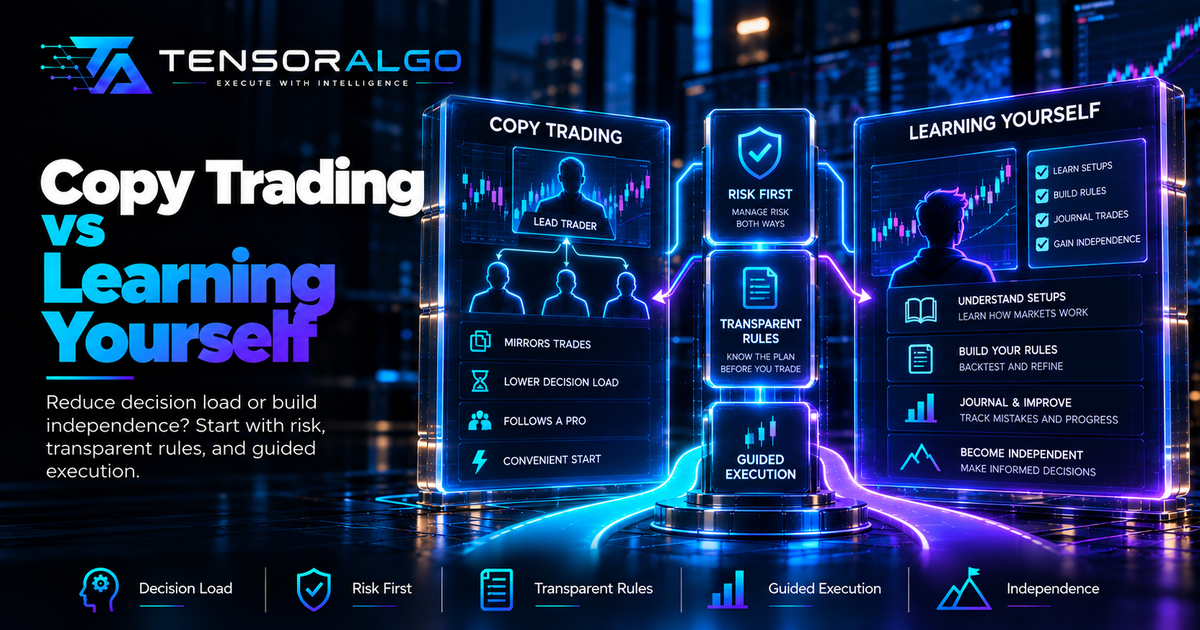
Copy trading and learning to trade yourself are often presented as opposite choices. One promises a faster route: find someone with experience and mirror what they do. The other asks you to build your own understanding, test ideas, make decisions, and accept a slower learning curve.
For a beginner, the real decision is more nuanced. Copy trading can reduce the number of decisions you need to make, but it does not remove market risk. Learning yourself can build independence, but it can also lead to months of random experimentation if you do not have a structured process.
The best path depends on what you are trying to solve. Do you lack market knowledge? Do you understand the market but struggle with execution? Are you looking for a framework you can learn from, or are you simply trying to outsource every decision?
This guide compares copy trading and self-directed learning from the perspective that matters most to a new futures trader: risk, skill development, transparency, discipline, adaptability, and long-term control.
What Copy Trading Actually Means
Copy trading is an arrangement in which one trader's decisions are replicated, followed, or translated into trades for another user. The exact implementation varies. Some services automatically mirror orders. Others provide trade instructions, model portfolios, alerts, or structured strategies that the user still chooses to execute.
That distinction matters. A fully automated copy relationship gives the follower very little control over each individual decision. A guided system can expose the reasoning, rules, entry conditions, stop logic, and exit process so the user remains involved.
ESMA's supervisory guidance on copy-trading services covers information requirements, costs, suitability and appropriateness, incentives, and the qualifications of traders whose activity is copied. That does not mean every copy-trading product works the same way, but it illustrates an important principle: the person being copied, the structure of the service, and the risks to the follower all matter.
For a beginner, the most dangerous misconception is that copying transfers responsibility to someone else. It does not. The trade still affects your account.
If you are new to derivatives, start by understanding what futures trading is before deciding how you want trading decisions to be generated.
What Learning to Trade Yourself Really Requires
Learning yourself does not mean staring at charts until you develop intuition. A useful learning process is much more structured.
CME Group's Building a Trade Plan course breaks the process into objectives, methodology, risk management, trading strategies, and a trader log. That is a better model for self-directed learning than jumping between indicators or copying whichever setup looked good on social media yesterday.
A beginner learning independently needs to answer questions such as:
- Which market am I trading and why?
- What conditions define a valid setup?
- What invalidates the idea?
- Where does the trade become too expensive relative to its potential reward?
- How much can I lose on one trade and one day?
- Which session or market environment does the setup belong to?
- How will I record trades and determine whether the approach is improving?
Those questions turn trading from continuous improvisation into a process. That is also the foundation of rule-based trading.
Copy Trading: The Main Advantages
It can reduce beginner decision overload
New traders often face too many simultaneous decisions. They are trying to read price, choose a direction, find an entry, place a stop, determine size, decide whether news matters, and manage emotions at the same time.
Following a transparent, pre-defined approach can narrow that decision set. Instead of inventing every trade from scratch, the beginner can focus on understanding why a setup exists and whether it is being executed according to its rules.
That can be valuable if the copied process is genuinely structured.
It can expose you to a complete workflow
A good process includes much more than an entry signal. It includes market selection, setup conditions, invalidation, risk, trade management, and review.
Seeing that full lifecycle can teach more than receiving isolated buy and sell messages. A beginner gets to observe how a strategy behaves when there is no trade, when a setup nearly qualifies, when it fails, and when the market changes character.
It can create consistency earlier
One of the hardest parts of learning is that beginners constantly change what they are doing. After two losing trades, they abandon one strategy. After seeing a profitable screenshot, they try another. The result is a collection of unrelated trades that cannot be evaluated as one system.
Following one documented process for a meaningful sample can provide consistency long enough to learn from the results.
Copy Trading: The Main Risks
You may copy the outcome without learning the process
If all you receive is a direction and an entry, you may become dependent on the source. You do not learn why the trade exists, which conditions matter, or when the same-looking setup should be rejected.
This becomes a serious problem when the source stops publishing, changes strategy, or enters a market regime where the approach performs differently.
A useful copied process should become more understandable over time, not more mysterious.
You still own the risk
The CFTC's Basics of Futures Trading advises futures customers to consider their experience, financial goals, resources, contract obligations, and how much they can afford to lose. None of those responsibilities disappear because another trader generated the idea.
This is why a follower still needs a personal risk-management framework. Your account size, loss tolerance, and maximum acceptable drawdown may be completely different from the person you follow.
Position size does not transfer cleanly
Imagine an experienced trader risks $400 on a setup. Copying the same number of contracts into a much smaller account can turn a reasonable risk for that trader into an extreme risk for you.
The correct question is not, “How many contracts did the other trader use?” It is, “What is the dollar risk from my entry to my invalidation, and how much of my account am I willing to expose?”
Our position-sizing guide explains the mechanics in more detail.
Performance can be misunderstood
A short winning streak does not prove that a trader or strategy has a durable edge. A screenshot does not show every skipped trade, losing trade, fee, slippage event, or change in execution.
You need enough history to understand the strategy's behavior rather than judging it from a handful of outcomes.
You also need to know whether results are live, simulated, backtested, or hypothetical. Those categories are not interchangeable: simulated results may not reproduce liquidity, slippage, decision pressure, or the practical difficulty of executing through losses.
Learning Yourself: The Main Advantages
You build independent judgment
The most important benefit of learning is not that you eventually predict the market better. It is that you become capable of evaluating a trading idea instead of accepting it because someone else said it was good.
You learn to ask:
- Does the setup match the current market condition?
- Is the stop logically placed or simply close enough to make the reward-to-risk ratio look attractive?
- Is there enough space to the target?
- Is the strategy behaving as expected over a useful sample?
- Am I following the rules or changing them after seeing the outcome?
That judgment helps even if you later use an execution assistant, playbook, alert service, or another trader's strategy.
You can adapt without starting over
Markets change. Volatility expands and contracts. Session behavior changes. A setup that works well in directional conditions may struggle in balance. Execution that is acceptable in a liquid period may become poor when conditions thin out.
If you understand the logic of your strategy, you can analyze those changes. If you only know how to copy the entry, you may not know what changed or what to investigate.
You can measure your own execution
Self-directed learning produces useful data when the process is consistent. You can separate strategy quality from execution quality.
For example, a setup may have been valid but you entered late. Or your direction may have been correct, but you widened the stop and damaged the trade's economics. Or the strategy may genuinely be underperforming in a particular regime.
A structured trading journal gives you the evidence needed to tell those situations apart.
Learning Yourself: The Main Risks
Beginners often confuse activity with learning
Taking more trades does not automatically create more skill. If each trade is based on different logic, the sample teaches very little.
Real learning needs repetition under comparable rules. That means defining what counts as a setup, what does not, and what information you will record.
Strategy hopping destroys the sample
A common beginner loop looks like this:
- Find a strategy.
- Take a few trades.
- Hit a losing streak.
- Assume the strategy is broken.
- Find a new strategy.
- Repeat.
The trader stays busy but never collects enough consistent evidence to understand anything properly.
Backtesting can help you learn how a strategy behaved historically, while forward testing helps you observe it under current conditions without immediately increasing financial risk.
Emotional execution can overwhelm good rules
Knowing what you should do is not the same as doing it in real time. Fear can make you skip a valid entry. FOMO can make you chase after the entry has gone. A loss can make the next trade feel like an opportunity to recover money rather than a new independent decision.
That is why self-directed trading needs external structure: checklists, fixed risk rules, alerts, a journal, and clearly defined setups.
Copy Trading vs Learning Yourself: Side-by-Side
| Question | Copy Trading | Learning Yourself | | --- | --- | --- | | Speed to begin | Usually faster | Usually slower | | Decision load | Lower if the process is structured | Higher at first | | Skill development | Depends on transparency | High if the process is systematic | | Dependency | Can be high | Lower over time | | Personal adaptability | Limited if logic is opaque | Stronger when logic is understood | | Risk ownership | Still yours | Yours | | Need for education | Yes | Yes | | Need for position sizing | Yes | Yes | | Need for review | Yes | Yes | | Best use | Guided exposure to a transparent process | Building independent competence |
The table reveals why “copy or learn” is the wrong binary. Both require risk knowledge. Both require review. Both can fail if used without structure.
The Better Beginner Model: Learn While Following a Process
A more practical path is to separate idea generation from understanding and execution.
You do not need to invent a completely original strategy on day one. You can start from a documented playbook, an experienced trader's framework, or a rule-based strategy. But you should know what the rules are and what risk the trade creates before you take it.
A useful progression looks like this:
Stage 1: Learn the instrument
Understand contract size, tick value, leverage, margin, trading hours, order types, and what happens when a position moves against you.
If those mechanics are unclear, copying trades is premature because you cannot properly evaluate the exposure being created.
Stage 2: Follow one transparent setup
Choose one setup with explicit conditions instead of ten loosely defined ideas. Learn when it qualifies, when it does not, where invalidation belongs, and how exits are managed.
Stage 3: Size the trade for your account
Never inherit somebody else's position size blindly. Translate the setup into your own risk limit.
Stage 4: Record every decision
Do not only record wins and losses. Record whether the setup was valid, whether you followed the entry rule, whether the stop changed, whether you exited early, and what the market environment looked like.
Stage 5: Review a sample, not one outcome
One trade proves almost nothing. A run of trades executed under the same rules gives you something you can analyze.
Stage 6: Increase independence gradually
As you understand the setup, begin evaluating it before seeing the external decision. Write down whether you believe it qualifies, then compare your reasoning with the playbook or experienced trader's process.
That turns following into active learning.
Where Trading Playbooks Fit
A trading playbook sits between blind copying and completely unstructured self-discovery. It converts a strategy into explicit conditions: what environment it belongs to, what has to align, what triggers an entry, what invalidates the trade, and how risk and exits should be handled.
If you want to build your own rules, the first Playbook guide shows the creation workflow. The important distinction is that the playbook should make the process inspectable. The goal is not to hide the strategy behind a signal; it is to make the decision process repeatable.
TensorAlgo is designed around this execution layer. It can help structure how a defined strategy is monitored and executed, but it does not turn a strategy into a guaranteed outcome and it does not remove the need for risk management.
Questions to Ask Before Copying Any Trader or Strategy
Before following someone else's decisions, ask:
- Are the rules visible? You should understand more than the direction of the next trade.
- How is risk defined? Look for clear invalidation and position-sizing logic.
- Are results distinguishable as live, simulated, backtested, or hypothetical? Those are not interchangeable.
- What happens during a losing streak? A strategy should have a process for bad periods, not just examples of winning trades.
- Are costs and execution differences acknowledged? Your fill may not match someone else's fill.
- Does the strategy fit the market you actually trade? Experience in one market does not automatically transfer to another.
- Can you explain the setup in your own words? If not, you are probably still dependent on the signal rather than learning the process.
Which Path Is Better for a Complete Beginner?
For most beginners, completely blind copy trading is a weak foundation. It can create the appearance of progress while leaving the trader unable to judge risk or strategy quality.
Completely independent learning can also be inefficient when it means randomly testing every indicator and concept on the internet.
A structured middle path is stronger:
- learn the market mechanics;
- define personal risk limits;
- use one transparent strategy or playbook;
- follow its rules consistently;
- record your execution;
- forward-test before increasing risk;
- gradually develop your own judgment.
This approach gives you the main benefit people want from copying—less decision chaos—without giving up the education needed to become independent.
FAQ
Is copy trading good for beginners?
It can be useful when the strategy is transparent, risk is independently controlled, and the beginner is actively learning the process. Blindly mirroring trades without understanding the instrument or risk can create dependency and does not remove the possibility of substantial losses.
Can I make money by copying a profitable trader?
There is no reliable guarantee. Even a trader with a strong historical record can have losing periods, and your results can differ because of timing, sizing, fees, slippage, or different account constraints. Historical results also do not guarantee future performance.
Is learning to trade yourself safer?
Not automatically. A beginner making unstructured decisions can take excessive risk just as easily as someone copying another trader. Safety depends more on risk limits, market understanding, position sizing, and execution discipline than on who generated the idea.
Should I create my own strategy immediately?
You do not need an original strategy to start learning. It can be more productive to study one well-defined setup first. The key is to understand the conditions and collect your own evidence rather than switching methods constantly.
Can I use both approaches?
Yes. A hybrid process can be effective educationally: follow a transparent strategy or playbook while independently learning the market, sizing trades for your own account, journaling the decisions, and comparing your own analysis with the defined rules.
Final Takeaway
Copy trading can reduce decisions, but it cannot outsource risk. Learning yourself builds independence, but it only works when learning is organized around a repeatable process.
For a beginner, the strongest objective is not to become dependent on someone else's next trade or to invent everything alone. It is to move from following rules you understand to evaluating and executing those rules independently.
That is a much more durable skill than simply knowing where the next entry is.