

Futures vs Options
Futures and options are both derivatives, but they create very different exposures. Futures are linear obligations; options add premium, strike, expiration, time and volatility to the decision.
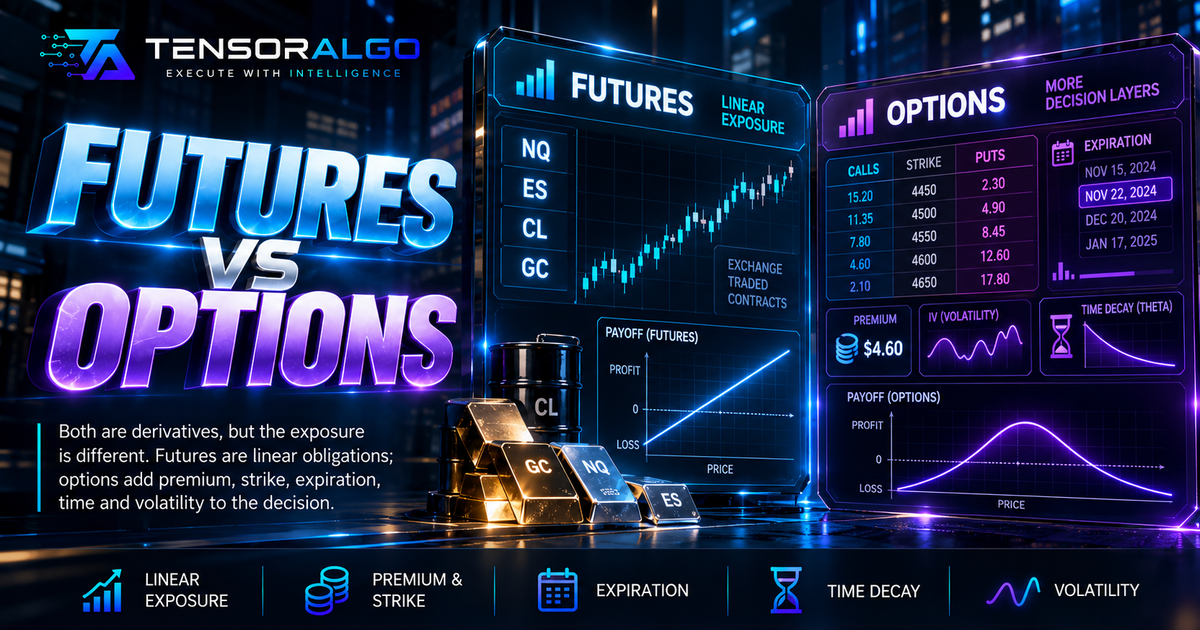
Futures and options are both derivatives, which is why beginners often assume they are simply two ways to make the same directional trade. Buy something bullish, sell something bearish, and choose whichever requires less capital.
That view misses the most important difference.
A futures contract creates a direct, approximately linear exposure to the underlying contract. If the futures price moves one point, the position's profit or loss changes by the contract's point value.
An option creates a different payoff. The buyer pays a premium for a right, not an obligation, to buy or sell the underlying at a specified strike according to the contract terms. The seller receives premium and takes on an obligation if the option is exercised or assigned.
That means an options trader is not only making a directional decision. The trader is also choosing a strike, expiration and premium exposure, while time and volatility can affect the option's value even when the underlying market moves in the expected direction.
Neither product is universally better. Futures can be simpler to model but can create substantial leveraged losses. Long options can define the premium at risk, but options add complexity and some option-selling strategies can carry very large risks.
The right comparison is not “which one makes more money?” It is “which exposure can I understand, size and manage correctly?”
Futures vs Options at a Glance
| Feature | Futures | Options | | --- | --- | --- | | Basic exposure | Linear exposure to futures price | Nonlinear right/obligation based on strike and expiration | | Buyer obligation | Futures position carries contractual obligations | Option buyer has a right, not an obligation, under contract terms | | Seller obligation | Both long and short futures have futures obligations | Option seller takes on exercise/assignment obligation | | Upfront economics | Margin/performance bond, not a purchase premium | Buyer pays premium; seller receives premium and may post margin | | Time decay | No option-style time decay | Time value generally changes as expiration approaches | | Volatility sensitivity | Price volatility affects P&L through market move | Implied volatility can affect option value independently of direction | | Expiration | Futures contract expires | Option expires; underlying may be a futures contract or other asset | | Payoff | Approximately linear | Nonlinear and strategy-dependent | | Complexity | Contract specs, leverage, roll | Contract specs plus strike, expiry, premium and Greeks/volatility |
This is a conceptual comparison. Actual contract rules, settlement and exercise mechanics depend on the listed product.
What Is a Futures Contract?
A futures contract is a standardized agreement traded on an exchange. The exchange specifies the underlying product, contract size, minimum price increment and expiration.
For an active trader, the key idea is that futures P&L is tied directly to the contract's price movement. If a contract is worth a fixed dollar amount per point, the position changes by that amount for each point the market moves, multiplied by the number of contracts.
Futures are leveraged. Traders post margin or performance bond rather than paying the full notional value of the contract. That capital efficiency also means position size can create meaningful losses quickly.
If these mechanics are new, start with What Is Futures Trading? and the Futures Trading Glossary before comparing more complex derivatives.
What Is an Option?
An option is a contract with a different allocation of rights and obligations. CME Group's Introduction to Options explains the core relationship among calls, puts, strike prices, expiration, premium, buyer rights and seller obligations.
A call option gives the buyer the right, under the contract terms, to buy the underlying at the strike price. A put option gives the buyer the right to sell at the strike price. The option seller, or writer, takes the corresponding obligation if exercise or assignment occurs.
The buyer pays premium for that right.
This immediately changes the risk structure. A long option buyer can generally lose the premium paid if the option expires worthless. But that does not mean “options have limited risk” as a universal statement. Short options and multi-leg strategies can create very different exposures, and uncovered option writing can involve substantial risk.
The Options Clearing Corporation's Characteristics and Risks of Standardized Options emphasizes that options involve risk and are not suitable for every investor. That is an important reminder for beginners who encounter options primarily through social-media claims about “defined risk.”
Difference 1: Linear vs Nonlinear P&L
Futures are relatively straightforward from a payoff perspective.
If you are long one futures contract and price rises, the position gains according to the contract's point or tick value. If price falls, the position loses accordingly. The relationship is approximately linear.
Options are nonlinear.
The price of an option depends on more than the underlying's current price. Important variables include:
- strike price;
- time remaining until expiration;
- implied volatility;
- whether the option is in, at or out of the money;
- interest-rate and contract-specific factors.
This means you can be correct about direction but wrong about the option trade.
For example, the underlying can move modestly higher while a call option still loses value because the move was too small, occurred too slowly, or was accompanied by a decline in implied volatility.
That is one of the biggest conceptual jumps from futures to options.
Difference 2: Margin vs Premium
A futures trader typically posts margin or performance bond to support the position. That amount is not the maximum loss. The position's loss is driven by how far the market moves and the contract's value.
An option buyer pays a premium. For a straightforward long option, that premium generally defines the maximum loss if the option expires worthless.
Beginners sometimes interpret this as meaning options are always safer. That conclusion is too broad.
First, repeatedly buying options that expire worthless can still produce substantial cumulative losses. Second, an option that appears inexpensive may have a low probability of finishing profitably or may require a large and fast underlying move. Third, selling options changes the risk entirely.
The correct risk comparison is strategy-specific.
Our Risk Management Guide provides the broader framework: define the exposure, calculate the amount at risk, and decide whether that risk fits the account before entering.
Difference 3: Time Matters Differently
A futures contract has an expiration date, but an open futures position does not lose value simply because another day passed while the underlying price remained unchanged.
Options are different because time value is part of the premium.
All else equal, the value associated with remaining time tends to decrease as expiration approaches. This is commonly described through theta or time decay.
That creates a new question for the option buyer: How quickly does the expected market move need to occur?
A futures trader can be early and still remain economically exposed to the same underlying price movement, subject to margin and contract-management constraints. An option buyer can be directionally right but too early if time decay meaningfully reduces the option's value before the move arrives.
Timing therefore has two meanings in options:
- when the underlying moves;
- how that timing interacts with expiration.
Difference 4: Volatility Becomes a Pricing Variable
For a futures trader, higher volatility changes how quickly and how far P&L can move. It can require wider stops and smaller position size.
For an options trader, volatility can also directly affect the option premium.
Implied volatility reflects the market's pricing of future uncertainty. An option can become more expensive when implied volatility rises and cheaper when it falls, even before considering the directional move.
This creates the familiar situation where a trader buys an option before a major event, predicts the direction correctly, but receives a disappointing result after the event because implied volatility collapses.
The directional thesis was not necessarily wrong. The option pricing thesis was incomplete.
Difference 5: Strike Selection
A futures trader chooses the contract and direction. The entry price then determines the immediate exposure.
An options trader must also choose a strike.
Different strikes create different combinations of:
- premium cost;
- directional sensitivity;
- probability of finishing in the money;
- leverage characteristics;
- time-value exposure.
A cheaper out-of-the-money option is not automatically better value. It may require a larger underlying move before expiration.
Likewise, a more expensive in-the-money option may behave more like the underlying, but the capital and risk profile differs.
Strike selection is therefore part of the strategy, not an afterthought.
Difference 6: Expiration Is More Central in Options
Both futures and options expire, but expiration plays different roles.
Futures traders often roll from one contract month to another when liquidity migrates. The position can be maintained by closing the expiring contract and opening a later one, subject to the strategy and market.
For an option, expiration is embedded directly into the payoff. At expiration, the option may be worthless, settled, exercised or assigned depending on the contract and its status.
Options on futures deserve particular attention because exercise can result in a futures position. A beginner who thinks they are “only trading options” can therefore end up with underlying futures exposure if they do not understand the contract mechanics.
Always know the exercise, settlement and expiration rules of the exact product you trade.
Difference 7: Long and Short Mean Different Things
In futures, going long or short produces roughly symmetric directional exposure. A long benefits from price rising; a short benefits from price falling.
In options, buying and selling are not simply mirror images.
- Buy call: right to buy the underlying at the strike.
- Buy put: right to sell at the strike.
- Sell call: obligation associated with the call if exercised/assigned.
- Sell put: obligation associated with the put if exercised/assigned.
The payoff shape and margin requirements vary significantly among these positions.
This is why a beginner should resist descriptions such as “selling premium is safer” or “buying options is safer.” The strategy must be defined before its risk can be evaluated.
Difference 8: Position Sizing Works Differently
For futures, a basic risk calculation can be straightforward:
entry-to-stop distance × dollar value per point × contracts \= planned dollar risk
The Position Sizing Calculator Guide explains this approach.
Options require additional decisions because premium can change nonlinearly with the underlying. A trader may size a long option by premium at risk, while more complex or short-option strategies require modeling the actual worst-case or scenario exposure.
The number of option contracts alone tells you little without knowing the premium, strike, expiration and underlying relationship.
Difference 9: Risk/Reward Can Be Misleading in Both Markets
Futures traders sometimes create attractive-looking reward-to-risk ratios by placing stops too close to the entry. Options traders can create attractive-looking percentage returns by buying very cheap contracts with low probability of success.
Both are examples of manipulating the appearance of the trade rather than improving the edge.
A useful strategy needs realistic assumptions about:
- where the thesis is invalid;
- how often the setup occurs;
- how often it wins;
- average win and loss;
- transaction costs;
- slippage;
- how market regime affects the setup.
These questions are central to what makes a trading strategy profitable.
Difference 10: Strategy Complexity
Futures can be complex because of leverage, contract specifications, roll mechanics and market microstructure. But a simple futures trade has a relatively transparent directional payoff.
Options can express much more complicated views:
- direction;
- volatility;
- time;
- range;
- event risk;
- asymmetric payoff;
- hedging.
That flexibility is powerful. It also means there are more ways to be wrong.
A beginner should not interpret complexity as sophistication. A two-leg, four-leg or volatility-based option structure is useful only if you understand what each leg is supposed to do and how the combined position behaves under different market scenarios.
When Futures May Be a Better Fit
Futures may fit a trader who wants:
- direct directional exposure;
- a transparent linear relationship between price movement and P&L;
- standardized exchange-traded contracts;
- active intraday trading;
- centralized volume and order-book data;
- a strategy based primarily on price, structure and defined stop/target geometry.
This does not mean futures are easy. Leverage makes poor sizing dangerous, and stop execution can differ from the intended price in fast conditions.
But the payoff is comparatively straightforward to model.
When Options May Be a Better Fit
Options may fit a trader or investor who wants to express:
- a directional view with a defined premium outlay;
- a volatility view;
- a time-specific thesis;
- an asymmetric payoff;
- hedging around an existing position;
- a range or multi-scenario strategy.
But those benefits only exist if the trader understands premium behavior and the chosen structure.
“Limited premium risk” is not the same as “easy to make money.” A long option can lose 100% of its premium. A short option can create very different and potentially substantial obligations.
Which Is Better for Day Trading?
Futures are widely used for active intraday strategies because of their standardized contract structure, liquidity in major products and direct price exposure.
Options can also be day traded, but short holding periods do not eliminate the importance of option pricing. The trader still has to choose strike and expiration and understand how the contract responds to the underlying.
For a beginner whose strategy is simply “I think NQ will move from this entry to that target with this invalidation,” the futures payoff may be easier to connect to the trade thesis.
For a trader whose thesis includes volatility or a carefully defined premium risk, options may offer structures that futures cannot replicate as directly.
Can You Use Options on Futures?
Yes. Options on futures combine the two markets.
The option's underlying is a futures contract. That allows traders to express views on futures markets using option structures. CME Group's Fundamentals of Options on Futures explains how premium, exercise, expiration, time value and volatility interact with the underlying futures contract.
However, this also means the trader needs to understand both layers:
- the underlying futures contract;
- the option contract written on that futures contract.
You need to know which futures month is underlying the option, how exercise and settlement work, and what position can result from assignment.
That is not a product to trade purely because the premium looks inexpensive.
How to Decide as a Beginner
Use a process rather than a preference.
1. Learn the underlying market first
If you cannot explain the futures contract, tick value and market behavior, adding an option layer will not simplify the problem.
2. Write the trade thesis in plain language
What do you expect the market to do, over what time period, and what invalidates the view?
3. Choose the exposure that matches the thesis
If the thesis is primarily directional and short-term, direct futures exposure may be easier to model. If the thesis specifically depends on time, volatility or asymmetric payoff, an option may be more appropriate.
4. Calculate worst-case and realistic loss scenarios
For a futures trade, calculate stop-based dollar risk and account exposure. For an option strategy, understand premium loss, assignment/exercise and scenario risk.
5. Test before scaling
Use historical analysis and then forward testing to see whether the strategy behaves as expected under current market conditions.
6. Keep the process rule-based
Whether you use futures or options, define the setup before entry. Our Rule-Based Trading guide gives a framework for turning the thesis into repeatable conditions.
How TensorAlgo Fits
TensorAlgo's core role is structured strategy execution. For futures workflows, a Playbook can make setup conditions, entry logic, invalidation, targets and monitoring rules explicit.
If you are creating your own process, the first Playbook guide explains how to structure those rules.
The platform is not a substitute for understanding derivative mechanics. It cannot turn an option into a futures trade or remove leverage risk. The product decision comes first; execution support comes after the strategy is defined.
FAQ
Are options safer than futures?
Not universally. A long option generally limits the buyer's maximum loss to the premium paid, but options can expire worthless and short-option strategies can have substantial risk. Futures can also create substantial losses because of leverage. Risk depends on the exact position and sizing.
Can you lose more than your initial investment in futures?
Futures losses can exceed the margin or initial amount posted, depending on market movement and account circumstances. Margin is a performance bond, not a maximum-loss amount.
Can you lose more than the premium when buying an option?
For a straightforward long option, the premium paid generally represents the maximum loss on the option position. Different outcomes can arise from exercise, transaction costs or more complex strategies, so the exact contract and account mechanics still matter.
Why can an option lose money when the market moves in the right direction?
Option value is affected by strike, time remaining, implied volatility and the magnitude of the underlying move. A directionally correct move can be too small or too slow to offset time decay or a change in implied volatility.
Do options on futures become futures positions?
Depending on the option contract and exercise/settlement rules, exercise or assignment can result in an underlying futures position. Traders should know the exact contract specifications before holding into exercise or expiration.
Which is easier to learn?
A simple futures position has fewer pricing dimensions, but futures leverage and contract specifications still require careful study. Options add strike, expiration, premium and volatility behavior. Beginners should learn the simpler exposure they can actually risk-manage rather than choosing based on perceived profit potential.
Final Takeaway
Futures and options can both express a market view, but they do not create the same trade.
Futures provide relatively direct, linear exposure to the listed contract. Options create rights and obligations with nonlinear payoffs shaped by strike, premium, time and volatility.
If your thesis is simple, keep the exposure simple. If you use options, make sure the added variables solve a real problem rather than merely making the trade look cheaper or more sophisticated.
Whichever product you choose, the standard remains the same: understand the contract, define the invalidation, calculate the real risk, test the strategy, and execute a repeatable process instead of improvising around the outcome.