

Gamma and GEX Explained: What Is Gamma Exposure in Trading?
Gamma and GEX have become important tools for traders looking to better understand options positioning and its potential impact on market price action. Here's what they actually mean.
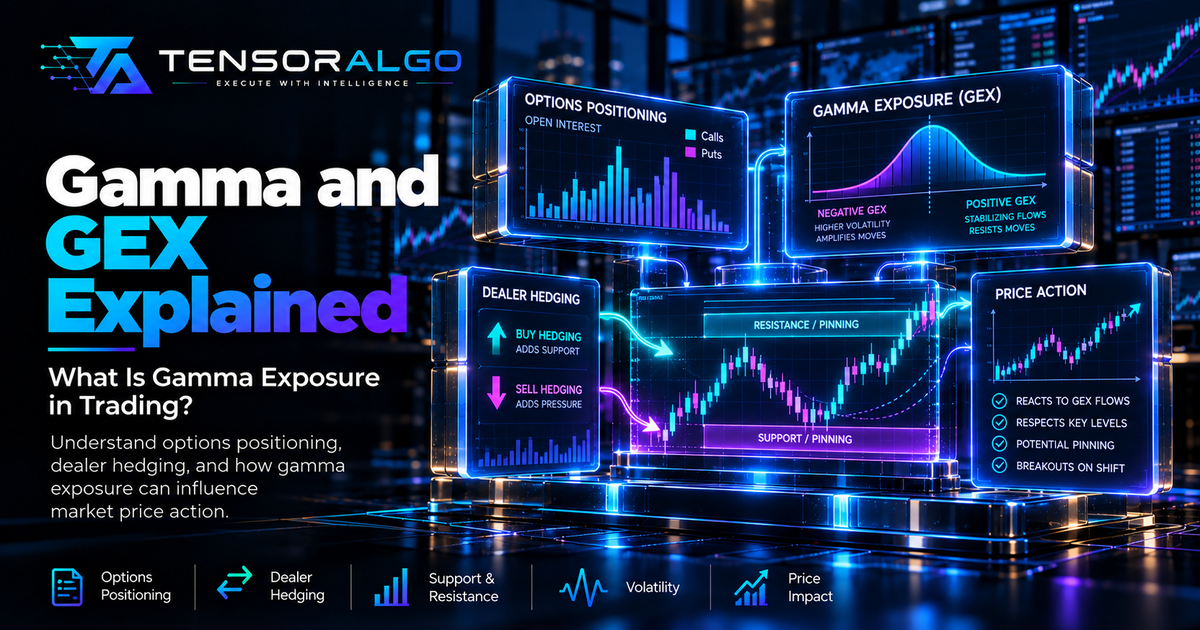
Gamma and GEX have become important tools for traders looking to better understand options positioning and its potential impact on market price action.
For options traders, GEX can provide another layer of market context. Traders often use gamma exposure to identify key price levels, understand potential changes in volatility, and analyze the broader options positioning behind the market.
In this guide, we explain what gamma and GEX are, how Gamma Exposure works, how dealer hedging can affect the market, and how to use it in your trading playbook.
What Is Gamma?
Gamma is an options Greek that measures how quickly an option's delta changes when the price of the underlying market moves.
Delta measures an option's sensitivity to changes in the underlying price. Gamma measures the rate at which that delta changes.
A Simple Gamma Example
Imagine a call option has:
- Delta: 0.50
- Gamma: 0.05
If the underlying rises by approximately $1, the option's delta could increase from around 0.50 to 0.55. As the underlying continues to move, the option's delta can continue changing.
That matters because options market makers and dealers may need to adjust their hedges as their directional exposure changes.
This process is known as delta hedging.
For a single option position, the adjustment may be small. But across millions of options contracts, those hedging flows can become significant.
What Is GEX?
GEX stands for Gamma Exposure.
Gamma Exposure is a measure of the aggregate gamma associated with options positioning across a market.
It typically considers factors such as:
- Options gamma
- Open interest
- Strike prices
- Contract size
- Expiration dates
- The price of the underlying market
GEX is used to estimate how options dealer hedging could potentially influence market behavior as prices move.
A simplified way to think about it is:
Gamma measures the sensitivity of an option. GEX measures the broader market exposure created by gamma.
This is why GEX is commonly used as a form of market structure analysis.
Is GEX for Options or Futures?
GEX is calculated from options data, but it can be used to analyze futures market context.
This distinction is important.
GEX comes from:
- Options open interest
- Options gamma
- Strike prices
- Expirations
- Options positioning estimates
Traders may use GEX to understand:
- Futures price behavior
- Volatility conditions
- Potential support and resistance
- Market regime
- Dealer hedging flows
- Areas where momentum may increase or decrease
For example:
SPX Options Positioning → Dealer Gamma Exposure → Hedging Activity → Potential Impact on ES Futures
Similarly:
NDX / QQQ Options Positioning → Gamma Exposure → Hedging Flows → Potential Impact on NQ Futures
This does not mean options positioning controls the futures market.
However, in highly liquid markets, options hedging can become an important part of the overall market structure.
Gamma and GEX in Crypto Trading
Gamma and GEX are also becoming increasingly relevant in crypto options markets, particularly for assets such as Bitcoin (BTC) and Ethereum (ETH).
The core concept is the same as in traditional options markets. As the price of Bitcoin or Ethereum moves, the delta of options contracts can change. This may require options market makers to adjust their hedges, potentially creating additional buying or selling pressure in the underlying market.
For example, a large concentration of Bitcoin options gamma around a specific price level may become an important area for traders to watch. Depending on the options positioning and dealer hedging activity, this can potentially influence:
- Price volatility
- Momentum
- Support and resistance
- Market liquidity
- Price behavior around major options strikes
Crypto GEX, or crypto Gamma Exposure, applies the same idea by analyzing aggregate gamma exposure across the crypto options market.
However, crypto traders should keep in mind that crypto options markets can behave differently from traditional equity and index options markets. Liquidity, market structure, exchange activity, and the size of the options market can all affect how strongly gamma-related hedging flows influence price.
Positive Gamma Explained
A market is often described as being in a positive gamma environment when estimated dealer gamma exposure is positive.
In this environment, dealer hedging may work against the immediate direction of the market move.
Conceptually:
- Market rises → dealers may sell to rebalance
- Market falls → dealers may buy to rebalance
This can potentially create a stabilizing effect.
If price rallies, hedging activity may introduce selling pressure.
If price declines, hedging activity may introduce buying pressure.
For traders, positive gamma environments are often associated with:
- Lower volatility
- Mean reversion
- Smaller price ranges
- Choppy trading
- Price moving back toward important strikes
For futures traders, this can mean a market that is more likely to rotate rather than trend aggressively.
Negative Gamma Explained
A negative gamma environment can produce a very different hedging dynamic.
Conceptually:
- Market rises → dealers may need to buy
- Market falls → dealers may need to sell
In this case, dealer hedging may move in the same direction as the market.
That can potentially amplify momentum.
For example:
ES futures start falling → dealer hedging requires additional selling → downside momentum increases
Or:
NQ futures rally → hedging flows require additional buying → upside momentum increases
This is why negative gamma environments are often associated with:
- Higher volatility
- Larger intraday ranges
- Stronger momentum
- Faster breakouts
- Sharper selloffs
A negative GEX environment does not guarantee a trend.
It simply means the market's hedging structure may be less stabilizing and potentially more sensitive to directional moves.
What Is a Gamma Flip?
A gamma flip is a price level where estimated aggregate gamma exposure changes from positive to negative, or from negative to positive.
Above a gamma flip, the market may have a more positive gamma profile. Below a gamma flip, the market may have a more negative gamma profile.
Traders often watch this area because it can represent a potential change in market behavior.
What Are Call Walls and Put Walls?
Two common terms in GEX analysis are call wall and put wall.
A call wall generally refers to a strike price with significant call options positioning. Traders may view this area as a potentially important market level.
A put wall generally refers to a strike with significant put options positioning. Depending on the market structure, traders may watch it as support, a downside risk level, and an important hedging area
Put GEX Into Your Trading Process with TensorAlgo
Gamma and GEX can provide valuable market context, but the key is knowing what to do with that information.
Use TensorAlgo to turn GEX levels into a structured trading Playbook. Define the market context, set your trading conditions, add your risk rules, and build a repeatable process around the setups you trade.
Start building your GEX trading workflow with TensorAlgo.