

How to Choose a Trading Strategy
The best trading strategy is not the one with the most impressive chart. It is the one you can define, test, risk appropriately and execute consistently in the market and session you actually trade.
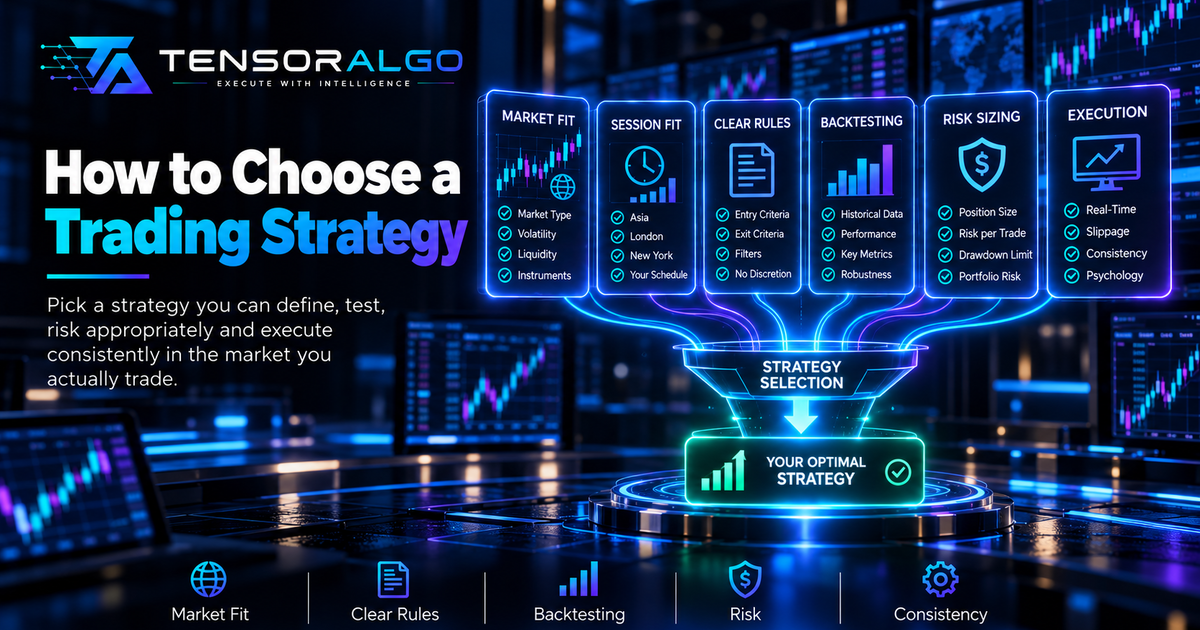
Choosing a trading strategy is one of the first decisions that feels important enough to determine everything that follows. Beginners often approach it by searching for the strategy with the highest win rate, the most dramatic screenshots, or the strongest recent performance.
That is usually the wrong starting point.
A trading strategy is useful only if three things are true at the same time:
- the logic is clear enough to test;
- the risk fits your account and financial situation;
- you can execute the process consistently in the market and session you actually trade.
A strategy can have attractive historical results and still be a poor fit for you. It may trade during hours you cannot monitor. It may require faster decisions than you can make. It may have normal losing streaks that cause you to abandon the rules. It may use stops that are too wide for your account. Or it may be so discretionary that you cannot tell whether two trades were really the same setup.
The goal, therefore, is not to find “the best strategy.” It is to find a strategy whose logic, risk, frequency and execution demands fit your reality—and then collect enough evidence to decide whether it deserves capital.
Start With the Market, Not the Indicator
Before choosing a strategy, choose the environment in which the strategy has to work.
A setup for NQ during the U.S. cash open is not automatically appropriate for gold in the Asian session. A multi-hour trend-following approach creates different operational demands from a five-minute pullback setup. A strategy designed around economic-release volatility requires different risk controls from one that avoids major events entirely.
If you are new to the product itself, review what futures trading is and the Futures Trading Glossary first. The CFTC's Basics of Futures Trading also stresses understanding contract obligations, financial resources and loss capacity before trading. Strategy selection becomes much easier once contract value, tick size, leverage, margin, session structure and order types are not mysterious.
Then narrow the problem:
- Which market or small group of markets will you trade?
- Which session can you realistically monitor?
- How long can you stay in a position?
- Can you actively manage a trade, or do you need rules that require less screen time?
- How much risk can one normal trade use without distorting your decision-making?
These constraints are not obstacles. They are filters.
A Strategy Is More Than an Entry Pattern
Many traders describe their strategy with a label: breakout, VWAP pullback, moving-average reaction, order block, mean reversion, momentum, trend following, liquidity sweep, opening range, or support and resistance.
Those labels describe an idea. They do not yet describe an executable strategy.
A complete strategy should answer at least these questions:
- What market condition must be present?
- Which setup is being monitored?
- What qualifies the setup?
- What exactly triggers the entry?
- Where is the trade invalid?
- How is position size calculated?
- Where is the first target?
- Is there a minimum acceptable reward relative to risk?
- When should the setup be skipped?
- Are there specific sessions or events in which the setup is disabled?
- How is an open trade managed?
- What information is recorded after the trade?
This is the difference between a chart pattern and a process.
Our guide to rule-based trading goes deeper into converting a trading idea into explicit decision rules.
Step 1: Define What You Want the Strategy to Do
CME Group's Building a Trade Plan course treats a trading strategy as one part of a broader plan that also includes objectives, methodology, risk management and a trader log. That is useful because it prevents a common mistake: choosing a strategy before deciding what the trading process is supposed to accomplish.
Consider the difference between these objectives:
- trade only the first two hours of the U.S. session;
- take one or two high-quality setups per day;
- hold positions for several hours;
- avoid holding through major scheduled events;
- trade only one futures market;
- build a process that can be reviewed from a small set of repeatable conditions.
Each objective eliminates strategies that do not fit.
A strategy that creates twelve signals a day may be unsuitable for a trader who wants low decision frequency. A strategy that requires monitoring every pullback may be unsuitable for someone with a full-time job. A strategy with rare but large stops may be unsuitable for an account that cannot tolerate the normal dollar risk.
Fit comes before excitement.
Step 2: Choose a Time Horizon You Can Actually Execute
Time horizon changes the entire trading experience.
Very short-term strategies
Scalping or short intraday strategies can provide frequent feedback, but they also demand fast decisions. Slippage, chasing, hesitation and execution quality can matter significantly because the expected move is relatively small.
A trader who freezes at the entry or repeatedly modifies the stop may struggle even if the strategy itself is sound.
Intraday strategies
Strategies that hold for several minutes to several hours can reduce some of the pressure of very short-term trading, but they still require a clear session plan and an understanding of scheduled events, volatility shifts and intraday structure.
Swing-style futures strategies
Longer holding periods may reduce decision frequency but can introduce overnight risk, larger stop distances, contract-roll considerations and a greater need to understand broader market drivers.
There is no universally superior horizon. The correct question is: Which horizon lets you follow the rules rather than constantly negotiate with them?
Step 3: Match the Strategy to the Market
A strategy can behave very differently across markets because contract specifications, liquidity, volatility and typical price movement differ.
A beginner often sees a setup demonstrated on one instrument and assumes it can be transferred unchanged to another. That can be a mistake.
If you are still deciding which contracts to focus on, the Best Futures Markets guide compares major choices from a practical trading perspective.
When evaluating a strategy-market combination, examine:
- typical volatility during your session;
- average stop distance required by the setup;
- dollar value of that stop for one contract;
- liquidity around your entry and exit times;
- frequency of major scheduled events;
- whether the setup depends on strong trends, balanced markets, breakouts or reversals;
- how often the setup actually appears.
Do not force a strategy into a market simply because you like the market's name or because somebody else trades it profitably.
Step 4: Calculate the Risk Before You Fall in Love With the Setup
A visually attractive strategy can be unusable if its normal risk does not fit your account.
CME's Risk Management and Your Trade Plan material asks traders to think about risk tolerance, leverage, maximum trade loss, maximum day loss and total exposure before trading. Those are strategy-selection questions, not just risk-management questions.
Suppose a setup usually requires an eight-point stop in one contract and a thirty-point stop in another. The second setup may be perfectly logical, but the dollar risk may exceed what your account can support at the minimum tradable size.
That does not mean the strategy is bad. It means it may be a bad fit for the account.
Use the logic in our Position Sizing Calculator Guide to translate the proposed stop distance into actual account risk.
Then ask:
- Can I take this trade without violating my per-trade risk limit?
- Can I survive a normal losing streak without increasing emotional pressure?
- Does the minimum contract size make the strategy too coarse for my account?
- Am I relying on an unrealistically tight stop merely to make the position affordable?
A strategy should fit the account without requiring you to distort its invalidation logic.
Step 5: Prefer Strategies With Observable Rules
If you cannot explain why a trade qualifies before seeing the outcome, the strategy is difficult to evaluate.
This is especially important for beginners because hindsight is powerful. After price moves, almost any chart can be explained with enough creativity.
A more testable strategy uses observable conditions. For example:
- price is above or below a defined reference;
- a specific structure has formed;
- a level has been tested or reclaimed;
- volatility is within a specified range;
- a trigger bar or confirmation condition occurs;
- the stop is placed beyond a defined invalidation point;
- the target is derived from a known level or fixed risk multiple.
The conditions do not have to be purely mechanical. Some strategies legitimately use judgment. But the judgment should still be constrained enough that trades can be grouped and reviewed.
The more a strategy depends on “I know it when I see it,” the harder it is to separate skill from hindsight.
Step 6: Understand the Strategy's Expected Behavior
Do not evaluate a strategy only by its win rate.
A strategy with a lower win rate can still have attractive economics if winners are substantially larger than losers. A high-win-rate strategy can still be fragile if occasional losses are very large or if transaction costs consume much of the small average gain.
Useful strategy characteristics include:
- win rate;
- average win;
- average loss;
- average reward-to-risk achieved, not merely planned;
- maximum losing streak in the tested sample;
- drawdown;
- trade frequency;
- average holding time;
- sensitivity to market regime;
- performance by session;
- performance after costs and realistic execution assumptions.
Our article on what makes a trading strategy profitable explains why expectancy matters more than a single attractive statistic.
The key point is that you need to know what “normal” looks like. Otherwise, the first difficult period will feel like evidence that the strategy stopped working.
Step 7: Backtest the Rules, Not the Story
Backtesting can help determine how a defined strategy would have behaved over historical data. It can reveal obvious weaknesses, estimate trade frequency and show whether the idea has any evidence behind it.
But a backtest is only as useful as the rules and assumptions used to create it.
Common problems include:
- changing rules while looking at past outcomes;
- ignoring transaction costs;
- using data that would not have been available in real time;
- optimizing so many parameters that the strategy fits the past rather than a durable market behavior;
- counting ambiguous trades in the most favorable way;
- excluding difficult periods without a rule-based reason.
Use our Backtesting Guide for a more detailed framework.
A good backtest should make you more skeptical and specific, not more certain.
Step 8: Forward-Test Before Meaningful Risk
Historical results do not reproduce every part of live execution. You still need to see how the strategy behaves in current conditions and how you behave when decisions occur in real time.
That is the role of forward testing.
A forward test can reveal problems that a backtest hides:
- the setup is harder to recognize live than in hindsight;
- signals cluster at inconvenient times;
- entries move too quickly for your workflow;
- the theoretical stop is difficult to execute consistently;
- you skip trades after losses;
- you take extra trades after winners;
- the strategy produces fewer qualified opportunities than expected.
The Forward Testing Guide covers how to collect this evidence before increasing risk.
A strategy should earn capital gradually.
Step 9: Test Whether You Can Follow the Strategy During Losses
Many strategies feel easy during a winning streak. The real fit test comes during drawdown.
Suppose a strategy has a normal losing sequence of five trades. Can you take trade six according to the same rules? Or will you cut size, skip the setup, change the target, or abandon the strategy?
If a strategy's normal variance causes you to stop following it, then the practical results you achieve may be far worse than the theoretical results.
This is why personal fit matters so much.
Ask:
- How many consecutive losses can I realistically tolerate without changing behavior?
- Does the strategy create enough trades for me to build confidence from evidence?
- Does it create so many trades that I start overtrading?
- Do the dollar swings remain psychologically manageable?
- Can I follow the process after a bad day?
A strategy that you can execute at 90% consistency may be more useful than a theoretically superior strategy you execute at 50% consistency.
Step 10: Watch for Strategy Complexity That Adds No Clear Value
Beginners often assume that a sophisticated strategy must contain many indicators, confirmations and filters.
Complexity can be useful when each component solves a specific problem. But unnecessary complexity creates two issues.
First, it becomes difficult to determine why a trade qualified. Second, the trader can selectively interpret the indicators to justify almost any decision.
A good rule is to ask what each component contributes.
If removing a filter does not materially change the strategy's behavior or risk profile, the filter may not be useful. If two indicators describe essentially the same underlying information, you may not be getting independent confirmation.
Simplicity does not guarantee quality, but testability improves when every rule has a reason to exist.
Step 11: Separate Strategy Quality From Execution Quality
One of the most valuable habits is reviewing the strategy and the trader separately.
For each opportunity, record:
- Did the strategy generate a valid setup?
- Was the setup taken?
- Was the entry according to plan?
- Was position size correct?
- Was the stop changed?
- Was the exit according to the strategy?
- What happened after the decision?
This lets you classify outcomes such as:
- valid setup, good execution, loss;
- valid setup, poor execution, worse loss;
- valid setup, skipped trade;
- invalid setup, impulsive trade;
- valid setup, good execution, win.
Without this separation, a trader can blame the strategy for execution mistakes or blame execution when the strategy genuinely lacks evidence.
Common Strategy-Selection Mistakes
Choosing the highest recent win rate
Recent performance can be influenced by the current market regime. A strategy that worked exceptionally well during one trend period may struggle when the market becomes balanced.
Choosing a strategy because a creator trades it
A strategy can be profitable for an experienced trader and still be inappropriate for your schedule, speed, account or risk tolerance.
Switching after a few losses
No strategy wins every trade. Switching methods after a small losing sample prevents meaningful evaluation.
Optimizing for excitement
Strategies with frequent action can feel productive while creating more opportunities for mistakes. A low-frequency strategy can be difficult emotionally because waiting feels unproductive. Neither is inherently better; choose what you can execute.
Ignoring the no-trade condition
A complete strategy includes conditions in which nothing should be done. If every market state can somehow qualify, the strategy is probably too vague.
A Practical Strategy-Selection Scorecard
Before committing to a strategy, score it from 1 to 5 on each dimension:
| Dimension | Question | | --- | --- | | Clarity | Can I explain exactly what qualifies? | | Testability | Can I identify the same setup historically and live? | | Risk fit | Does one normal trade fit my account? | | Schedule fit | Can I monitor the required session? | | Frequency | Does it provide enough but not excessive opportunities? | | Execution speed | Can I enter and manage it reliably? | | Drawdown tolerance | Can I follow it through normal losing periods? | | Data availability | Can I collect enough trades for evaluation? | | Market fit | Does it suit the contract and session I trade? | | Simplicity | Do the rules have clear purposes? |
A low score does not automatically reject the strategy. It tells you where the operational risk is.
How Trading Playbooks Help
A strategy becomes much easier to evaluate once it is written as a playbook: context, setup conditions, trigger, entry, invalidation, targets and management rules.
If you are building your own framework, the first Playbook guide explains how to turn trading logic into a structured TensorAlgo workflow.
TensorAlgo's role is not to declare that one strategy is universally best. The platform is designed to help monitor defined conditions and support more consistent execution of a strategy you have chosen and specified.
That distinction is important. Software can reduce decision friction and improve process visibility. It cannot make an untested strategy profitable or remove market risk.
FAQ
What is the best trading strategy for beginners?
There is no single best strategy for every beginner. A suitable beginner strategy is usually understandable, testable, affordable at minimum position size, compatible with the trader's schedule and limited enough that execution can be reviewed consistently.
Should beginners choose a high-win-rate strategy?
Not based on win rate alone. Average win, average loss, costs, drawdown, trade frequency and execution difficulty all matter. A strategy with a high win rate can still have poor economics if losses are disproportionately large.
How long should I test a strategy?
There is no universal number of days or trades that proves a strategy works. The sample should be large and varied enough to observe normal wins, losses and different market conditions. Avoid drawing strong conclusions from a handful of outcomes.
Can I trade more than one strategy?
Yes, but beginners often learn faster with fewer variables. It can be useful to establish one clearly defined setup before adding another, so each strategy's results remain identifiable.
Should I change a strategy after a losing streak?
Not automatically. Compare the losing period with the strategy's tested behavior. Verify whether trades were executed according to plan and whether market conditions changed. Change rules because the evidence supports a revision, not simply because losses are uncomfortable.
Can AI choose my strategy for me?
AI can help organize information, monitor conditions and support analysis, but strategy selection still requires understanding risk, assumptions, data quality and personal constraints. Treat AI as decision-support tooling rather than a guarantee of future performance.
Final Takeaway
The right trading strategy is not the one that looks most impressive in hindsight. It is the one you can describe before the trade, size responsibly, test with real rules and execute consistently when outcomes are uncertain.
Choose the market and session first. Define your risk. Make the setup observable. Backtest without rewriting history. Forward-test in current conditions. Record plan versus execution. Then increase capital only when both the strategy and your behavior have produced enough evidence to justify it.
That process may feel slower than chasing the latest strategy. It is also how you stop starting over every few weeks.