

How to Stop Revenge Trading
Revenge trading starts when a previous loss changes the rules for the next decision. The fix is not willpower alone—it is a process with smaller risk, hard limits, a pause and a checklist that survives emotional pressure.
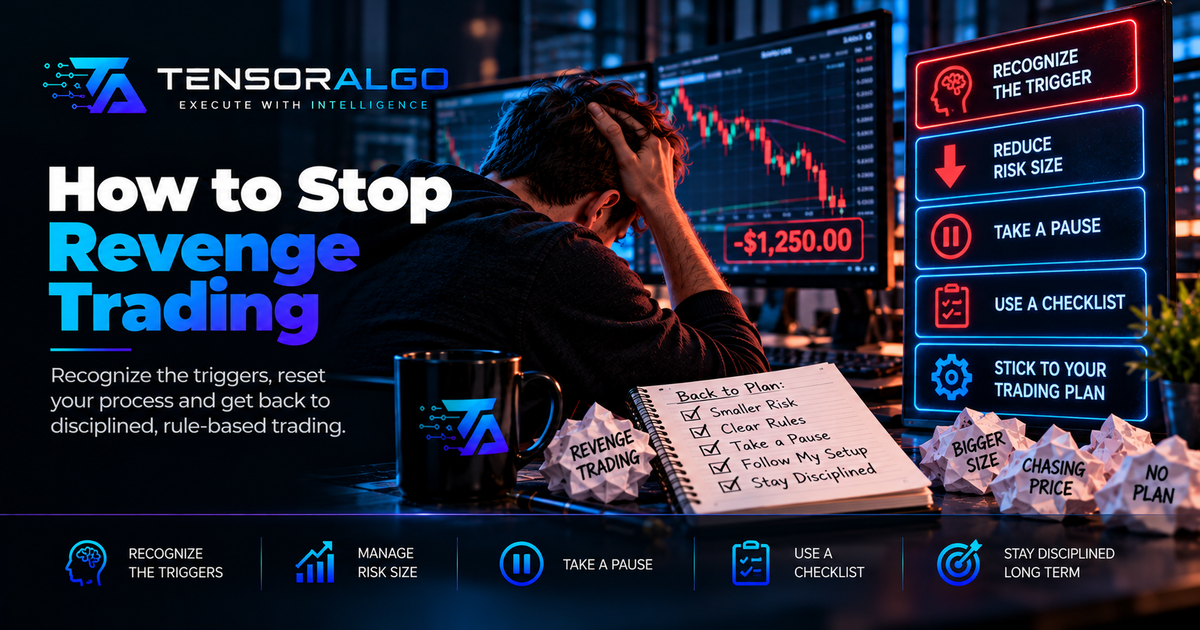
Revenge trading begins with a simple change in objective.
Before the loss, the goal is to execute a strategy. After the loss, the goal becomes to recover money.
That shift can happen quickly. A trader who normally waits for a clear setup suddenly enters early. Position size increases. A stop gets wider. A mediocre trade becomes “good enough” because it offers a chance to get back to breakeven.
The problem is not merely that the trader feels frustrated. The problem is that the previous outcome starts changing the rules for the next decision.
That is why revenge trading is dangerous in leveraged markets such as futures. The trade after a loss often carries more risk precisely when judgment is under more pressure.
The solution is not to promise yourself that you will “be more disciplined next time.” A better solution is to build a process that makes revenge trading harder to execute.
What Is Revenge Trading?
Revenge trading is trading motivated by the desire to recover a previous loss rather than by the independent quality of the current setup.
It can look obvious:
- doubling position size after a loss;
- immediately re-entering without a valid setup;
- widening the stop to avoid another realized loss;
- trading outside your normal session;
- taking lower-quality setups because you are behind.
But it can also be subtle.
You may still trade the same market and use the same setup name, yet your threshold for taking the trade has changed. A setup that you would normally reject suddenly becomes acceptable because the previous trade lost.
That is still revenge trading.
Why Losses Change Decision-Making
Losses are emotionally difficult because they are not experienced as neutral information.
CME Group's Planning for Trading Losses discusses the difficulty of making sound financial decisions under duress and emphasizes having loss-handling rules before the stressful moment arrives. In a controlled monetary decision task, a peer-reviewed study indexed by PubMed found participants were more risk-seeking after losing a gamble than after winning one, illustrating how prior outcomes can influence subsequent risky decisions.
That does not mean every trader responds to losses in the same way, and laboratory gambling tasks are not the same as futures trading. It does mean that relying on perfect emotional neutrality is a weak risk-control plan.
A more practical assumption is:
After a meaningful loss, my decision quality may be less reliable than it was before the loss.
Once you accept that possibility, the correct response is to reduce discretion.
The Core Pattern: Loss → Urgency → Lower Standards
Revenge trading usually follows a recognizable sequence.
1. A loss happens
The trade may have been perfectly valid or completely impulsive. Emotionally, both can hurt.
2. The trader creates a recovery target
“I just need one good trade to get it back.”
3. Time pressure appears
The loss begins to feel temporary only if it can be recovered today.
4. The setup threshold falls
The trader starts seeing opportunities that would have been rejected earlier.
5. Risk increases
Size, stop distance, trade frequency or all three increase.
6. Another loss becomes more damaging
Now the trader is not only losing on a trade. The trader is losing while trying to repair the previous loss.
This often intensifies the cycle.
Revenge Trading Is Not the Same as Taking the Next Valid Trade
This distinction matters.
A strategy can legitimately produce another qualified setup immediately after a loss.
Taking that trade is not automatically revenge trading.
The key question is whether the second trade would have been taken if the first trade had been a winner.
If the setup quality, position size and decision process are unchanged, it may simply be the next valid trade.
If the previous loss is the reason you are entering, sizing differently or lowering your standards, the process has changed.
This is why written rules matter. They give you something objective to compare against. CME Group's guidance on trading strategies within a trade plan similarly recommends defining setup, trigger and trade-management rules before emotions are involved.
Sign 1: You Increase Size to Recover Faster
This is one of the clearest forms of revenge trading.
Suppose your normal trade risks $150. After losing, you decide the next trade should risk $300 because one winner could restore the account more quickly.
The market has not provided a better setup. The position is larger because of your P&L.
That means size is no longer determined by the trade.
Your Position Sizing Calculator Guide should produce the same answer whether the previous trade won or lost.
If the previous outcome changes the number of contracts, that should happen only because your written risk plan requires it—not because you want money back.
Sign 2: You Trade Faster After a Loss
A trader who normally waits twenty minutes for a setup may re-enter two minutes after being stopped out.
Sometimes that is valid. Often it is a sign that the trader is no longer observing the market objectively.
The fastest way to detect this is to compare post-loss trade timing with normal behavior.
Ask:
- Did I wait for the same trigger?
- Did the market reset enough for the next setup to exist?
- Did I enter because the condition appeared, or because I was still focused on the previous position?
A mandatory pause can help because it breaks the emotional continuity between the loss and the next decision.
Sign 3: You Start Calling Weak Setups “Close Enough”
Revenge trading rarely announces itself with the words “I am taking a bad trade.”
It usually arrives as justification.
- “This is basically the setup.”
- “The level is close enough.”
- “I don't need full confirmation this time.”
- “It already moved once, so it should move again.”
The problem is not flexibility by itself. Some strategies legitimately use judgment.
The problem is that the standard changes after the loss.
This is why Rule-Based Trading is so useful. A written setup does not eliminate judgment, but it makes it easier to notice when your criteria are being rewritten under pressure.
Sign 4: You Widen the Stop
A revenge trade often begins with higher emotional stakes.
That makes the next stop harder to accept.
Price approaches invalidation, and the trader gives the position more room because another realized loss feels unacceptable.
Now the original risk calculation no longer applies.
The loss has changed both the entry decision and the exit decision.
A complete Risk Management Guide should define how invalidation and account-level loss limits interact before the trade begins.
Sign 5: You Keep Trading After Your Normal Session Ends
A common version of revenge trading is extending the day.
Your normal plan may be to trade the first two hours of the U.S. session. After a loss, you stay another hour because you want to finish green.
The market environment may now be different. Liquidity and volatility may have changed. Your strategy may not even be designed for that period.
The extra trade is no longer only about setup quality. It is also about restoring the day's result.
Sign 6: You Stop Caring About the Market and Start Watching P&L
During revenge trading, the account balance becomes the main chart.
The trader thinks:
- “I need $240 to get back to flat.”
- “One NQ winner can fix this.”
- “If I get half back now, I can try again later.”
None of these thoughts describe the market.
They describe the trader's financial state.
The market does not know your breakeven point. A setup's expectancy does not improve because your daily P&L is negative.
The Most Important Rule: Never Let the Previous Trade Set the Risk of the Next Trade
Every new trade should begin with the same sequence:
- Does the setup qualify?
- Where is invalidation?
- What is the dollar risk at the minimum tradable size?
- Does that fit the risk budget?
- Is the trade still valid at the available entry?
The previous trade should not appear anywhere in that calculation unless your written plan contains a specific drawdown rule.
For example, your plan may require reducing size after two losses. That is very different from increasing size because you are angry.
Use a Personal Daily Stop Before the Firm or Broker Forces One
A daily stop is one of the strongest revenge-trading controls because it removes the ability to negotiate indefinitely with yourself.
The number should be set before the session.
Your personal daily stop may be based on:
- a maximum dollar loss;
- a maximum number of R lost;
- a maximum number of failed attempts;
- a combination of these.
The exact level depends on the strategy and account. The principle is more important than the number.
Once the limit is reached, the session ends.
Not “unless the next setup looks perfect.”
Not “unless the market gives one more opportunity.”
The limit exists precisely because your judgment is most likely to challenge it after the loss.
Use a Maximum Number of Attempts
Some strategies can generate several valid entries in one session. Others rarely produce more than one or two.
A maximum-attempt rule protects against turning a difficult session into an unlimited series of trades.
For example:
- maximum three qualified attempts;
- stop after two consecutive losses;
- stop after one rule violation;
- no re-entry unless the entire setup resets.
The correct rule depends on the strategy. What matters is that it exists before the session begins.
Use a Post-Loss Pause
A pause is not a punishment.
It creates separation between one outcome and the next decision.
During the pause:
- record the trade;
- confirm whether it was valid;
- identify whether the loss came from strategy or execution;
- reset the platform and chart view if necessary;
- wait until a new setup actually forms.
The pause can be time-based, event-based or both.
For example:
- ten minutes minimum;
- until a fresh five-minute structure forms;
- until the next predefined setup window;
- until the journal entry is complete.
A fixed process removes the temptation to re-enter simply because price moved immediately after the stop.
Separate Valid Losses From Trading Mistakes
Not every loss requires correction.
A valid strategy can lose.
Your journal should classify trades at least four ways:
- valid setup, correct execution, loss;
- valid setup, poor execution, loss;
- invalid setup, impulsive trade;
- valid setup, correct execution, win.
That distinction is critical.
If a perfectly valid trade loses, the correct response may be to do nothing except record it.
If you immediately try to recover every valid loss, you are treating normal strategy variance as an error that must be repaired.
The Trading Journal Guide provides a more complete review structure.
Create a Revenge-Trading Trigger Checklist
You can make the problem easier to detect by listing your personal warning signs.
Examples:
- thinking about breakeven more than the setup;
- wanting to increase size;
- entering before confirmation;
- refreshing P&L repeatedly;
- feeling that the session “cannot end like this”;
- widening the stop;
- switching markets to find movement;
- abandoning the normal setup;
- trading after the session window;
- taking a trade you cannot explain clearly.
If two or more appear, activate a predefined circuit breaker.
The 90-Second Recovery Audit
Before taking another trade after a meaningful loss, answer these questions in writing or verbally:
- What setup am I trading?
- Which exact conditions are satisfied?
- What invalidates the trade?
- What is my planned dollar risk?
- Is this the same size I would use if the previous trade had won?
- Has the entry already been missed?
- Would I still take this trade if today's P&L were zero?
The seventh question is especially useful.
If the answer is no, the trade is probably about recovery rather than strategy.
Reduce Size After Emotional Instability, Not Increase It
If you notice that losses are changing your behavior, the appropriate response is usually to reduce pressure.
That can mean:
- smaller position size;
- fewer trades;
- simulation or forward testing;
- stopping for the day;
- returning to one market and one setup.
Increasing size to “build confidence back” usually does the opposite.
The dollar swings become larger, which makes emotional control harder.
Do Not Use a Daily Profit Goal as a Recovery Obligation
A trader who begins the day with a $500 target may feel that a $300 loss creates an $800 problem.
The strategy now has to recover the loss and produce the original target.
That is an artificial requirement.
The market is not obligated to offer enough qualified setups to meet your daily number.
Process goals are more useful:
- take only qualified setups;
- keep risk fixed;
- stop at the daily loss limit;
- do not chase entries;
- record every decision.
Profit remains important, but it is an outcome rather than an order you can give the market.
What If You Revenge Trade During a Prop Challenge?
Prop evaluations can intensify revenge trading because the trader is aware of both the profit target and the drawdown limit.
A loss feels like lost progress and reduced survival room at the same time.
The temptation is to recover quickly before the challenge becomes harder.
The better approach is the opposite: reduce risk as the available drawdown buffer shrinks.
Do not let the challenge deadline or fee change the setup quality required for the next trade.
What If the Market Reverses Immediately After Your Stop?
This is one of the strongest revenge triggers.
You exit correctly. Price immediately reverses and runs toward your original target.
Now the loss feels unfair.
The trader wants to re-enter to prove the original idea was right.
But a direction being correct later does not mean the original stop was wrong or that a new trade exists now.
Ask whether the strategy has a defined re-entry condition.
If it does, follow it.
If it does not, create and test one during review—not in the middle of frustration.
Use Forward Testing to Practice the Recovery Process
Revenge trading is partly an execution habit, which means it can be trained without full live risk.
During Forward Testing, do not only evaluate whether the setup wins.
Practice what happens after a loss:
- take the pause;
- complete the checklist;
- keep size unchanged;
- reject weak setups;
- stop at the daily limit.
You are testing your process under sequence pressure, not just the strategy's entry logic.
How TensorAlgo Can Help
TensorAlgo is designed to make trading rules more explicit.
A Playbook can define the setup, required conditions, entry logic, invalidation and target framework before the emotional moment arrives.
That does not eliminate revenge trading automatically. A trader can still ignore a plan.
But a structured system makes deviations easier to detect. You can compare what the playbook required with what you actually did.
If you want to formalize your setup, the first Playbook guide explains how to create one.
The goal is not to remove human judgment. It is to stop judgment from being rewritten by the last trade.
A Practical Anti-Revenge Trading Protocol
Before the session
- Define maximum risk per trade.
- Define maximum risk per day.
- Define maximum attempts.
- Write the setup requirements.
- Decide the post-loss pause rule.
- Decide the rule-violation stop condition.
After any loss
- Log the trade.
- Classify it as valid or invalid execution.
- Step away for the required pause.
- Reset the chart and P&L focus.
- Recalculate risk from the next setup independently.
Before the next trade
- Confirm every setup condition.
- Use the same sizing process.
- Ask whether you would take it if P&L were flat.
- Reject the trade if the only reason to act is recovery.
If revenge trading starts anyway
- End the session.
- Record exactly where the process changed.
- Do not try to repair the day with another trade.
- Reduce size or return to simulation until the rule can be followed consistently.
FAQ
What is revenge trading in simple terms?
Revenge trading is taking or changing a trade because you want to recover a previous loss, rather than because the current setup independently meets your strategy rules.
Is taking another trade after a loss always revenge trading?
No. If the next setup fully qualifies and risk remains unchanged, it can simply be the next valid trade. The warning sign is when the previous loss changes your entry threshold, size, timing or risk.
How long should I wait after a losing trade?
There is no universal number. The pause should be long enough to break the immediate recovery impulse and allow a genuinely new setup to form. Some traders use a fixed time; others require a complete market-structure reset or journal review.
Should I reduce size after a losing streak?
A written risk plan can include size reduction after drawdown. That is different from changing size emotionally. If losses are making execution unstable, reducing risk can lower pressure while you diagnose the problem.
How do I know if I am revenge trading?
Ask whether you would make the same decision if the previous trade had been a winner or if today's P&L were zero. If not, the previous loss is influencing the trade.
Can a trading platform stop revenge trading?
Software can help by enforcing structure, alerts, risk limits and review. It cannot guarantee discipline. The trader still needs predefined rules and must respect the stop conditions.
Final Takeaway
Revenge trading is not solved by becoming emotionless.
It is solved by preventing emotion from changing the rules.
Keep position sizing independent from the previous outcome. Use a hard daily stop. Limit attempts. Create a post-loss pause. Journal whether the trade was valid. Require the same setup conditions after a loss as before it.
The objective after losing is not to get the money back immediately.
It is to make the next decision as if the previous trade no longer has authority over it.