

Prop Trading Explained
Understand how modern futures prop evaluations differ from traditional proprietary trading. Compare targets, drawdown rules, consistency constraints, payouts and provider risk before deciding whether a program fits your process.
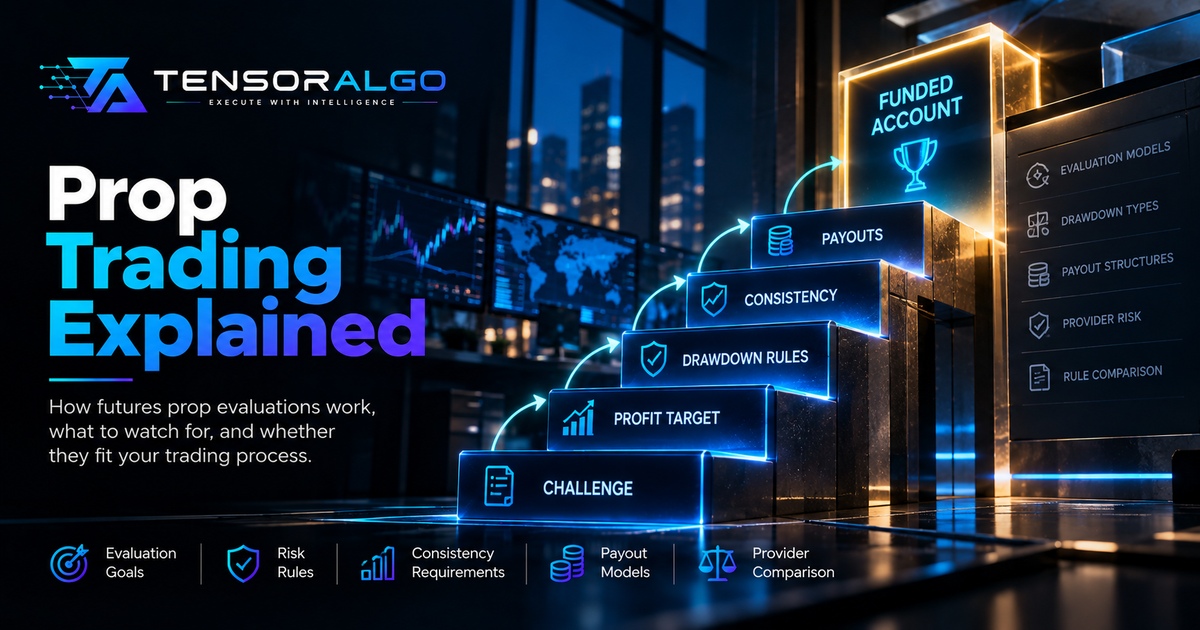
Prop Trading Explained: Evaluations, Funded Accounts, Risk Rules, and What to Check
“Prop trading” can describe several business models. In online futures trading, the term often refers to evaluation programs in which traders follow a provider's rules to qualify for a simulated or funded-style account arrangement.
Educational information only. Program terms differ and change. Read the current provider rules and legal disclosures directly before paying or trading.
Traditional proprietary trading
A traditional proprietary trading firm trades the firm's own capital and employs or contracts traders within its risk framework. Compensation, capital allocation, technology, and employment structure vary.
This is not necessarily the same model as retail-accessible online evaluation programs.
The evaluation model
A typical evaluation sets objectives and risk constraints such as:
- profit target;
- maximum or trailing drawdown;
- daily loss limit;
- minimum trading days;
- consistency rules;
- permitted products/hours;
- restrictions around events or holding periods.
Passing an evaluation does not by itself describe the economics or legal nature of the next stage. Read what the provider means by “funded,” “performance,” and “payout.”
Simulated versus live capital
Some programs use simulated environments for evaluations and/or subsequent stages; others may route some traders or trades differently. Marketing terminology can obscure this distinction.
Check the provider's current disclosures rather than assuming an account label means orders are being placed in a live exchange account.
Trailing drawdown
A trailing threshold can move upward as account equity or balance reaches new highs, depending on the provider's exact rule. This changes usable risk.
Do not size from the headline account number alone. Model the distance to the actual failure threshold and understand when/if the threshold stops trailing.
Daily loss limits
A daily loss rule can include realized P&L, unrealized P&L, commissions, or different reset times depending on the program.
Know the time zone and exact calculation. “I had risk left” is not useful if the platform calculates the limit differently.
Profit targets and consistency
A target creates an incentive to focus on gains; risk rules determine whether the path is survivable. Some programs also limit how concentrated profits can be in one day or apply other consistency criteria.
Build the strategy around repeatable risk, not around forcing a target before a deadline.
Fees and payout terms
Evaluate:
- evaluation/subscription fees;
- activation or data fees;
- reset costs;
- payout eligibility;
- payout split;
- minimum/maximum withdrawals;
- waiting periods;
- account scaling;
- termination conditions.
The lowest advertised evaluation fee is not necessarily the lowest total cost.
Why over-sizing is dangerous
A trader may technically be allowed many contracts while the drawdown threshold makes that size impractical. Maximum platform size is a permission ceiling, not a risk recommendation.
Calculate risk from stop distance and threshold capacity.
Multiple accounts and copying
Some programs allow multiple accounts or trade copying under specific conditions; others restrict it. Check current rules before using copier software.
Operational errors can multiply across copied accounts, so reconciliation and maximum aggregate exposure matter.
Strategy fit
A strategy suited to a personal brokerage account may conflict with a prop program's restrictions. Consider:
- typical drawdown;
- holding time;
- overnight exposure;
- news-event behavior;
- trade frequency;
- required contract size;
- losing streaks.
Evaluate the rule set against the strategy distribution, not only the best-case path.
Due diligence checklist
Before joining a program, verify:
- legal entity and current terms;
- whether stages are simulated or live;
- all fees;
- drawdown calculation;
- daily reset time;
- payout rules;
- prohibited strategies;
- data/platform requirements;
- account closure conditions;
- support/escalation process.
Save a copy of the terms applicable when you enroll.
Two Meanings of Prop Trading
Traditional proprietary firms trade firm capital within an institutional business. Retail-accessible evaluation businesses can use a different model involving paid evaluations, simulated accounts and contractual payout rules. Do not assume the word “funded” describes identical legal or execution arrangements across providers.
Read the Rulebook as a Risk Model
Translate every rule into a variable: loss threshold, trailing mechanism, reset time, maximum quantity, permitted products, holding restrictions, payout conditions and consistency rules. Then simulate your strategy distribution against those constraints before paying for an evaluation.
Trailing Drawdown Example
If a threshold trails a high-water mark, profitable intraday excursions can sometimes change available room depending on the provider's exact formula. Model the rule precisely—balance versus equity, realized versus unrealized, end-of-day versus intraday—and never infer it from the marketing account size.
Evaluation Economics
Calculate expected total cost, not only the headline fee: subscriptions, resets, activation/data charges where applicable and the probability that repeated attempts are needed. Promotional discounts can change; use the provider's current terms rather than an old review article.
Simulated Performance
A simulated environment can be useful for evaluating rule adherence, but fills and psychological incentives can differ from a personal live brokerage account. Understand what the provider actually simulates and what it means by payout or funded status.
Due Diligence
The CFTC and NFA BASIC provide investor education and registration/background resources for the regulated U.S. derivatives ecosystem. An evaluation provider's specific regulatory status and contractual model should be verified rather than inferred from the word “trading.”
Strategy Compatibility
Backtest the constraints as part of the strategy. A playbook with ordinary 8R historical drawdowns may be structurally incompatible with an account whose usable threshold is much smaller. Passing quickly in one favorable sample does not repair that mismatch.
Payout Risk and Counterparty Terms
A displayed account balance is not the same as cash already received. Read payout eligibility, review procedures, prohibited conduct, dispute terms and termination clauses. Keep copies of the terms that applied when you enrolled.
Operational Risk Across Multiple Accounts
Trade copying can multiply both intended orders and mistakes. If a provider permits copying, cap aggregate exposure and verify all accounts reconcile after partial fills, disconnects or rejects. One local error should not silently become many.
A Prop Workflow in TensorAlgo
A user can encode setup and risk rules in a TensorAlgo Playbook and review activity without TensorAlgo acting as the prop firm or broker. Combine that structure with the Risk Management Guide and always treat the provider's current contractual rules as authoritative.
Model the Evaluation Before Buying
Take your historical trade sequence and apply the provider's exact loss thresholds, reset rules and permitted quantity. This can reveal whether an otherwise acceptable strategy regularly violates the program structure.
Static Versus Trailing Limits
A static threshold stays fixed; a trailing threshold moves according to a defined high-water mechanism. Some trail intraday equity, others use different definitions. Small wording differences can materially change usable risk.
Reset Times
Daily rules depend on a clock. Record the provider's stated timezone and whether unrealized P&L is included. A trade spanning the reset can behave differently under the rules than a trader expects.
Consistency Rules
Some programs restrict concentration of gains or impose related payout conditions. Model those rules from current documentation. Do not design a strategy around a remembered percentage from an old promotion or review.
Payout Due Diligence
Before treating expected payouts as part of a business plan, understand eligibility dates, minimum trading activity, review processes, maximum withdrawal rules and the provider's contractual discretion. Terms can change.
Taxes and Legal Status
Tax and legal treatment depends on jurisdiction and arrangement. A prop-style payout may not be treated identically to P&L in a personal futures account. Obtain appropriate professional advice rather than relying on trading forums.
Psychological Incentives
Evaluation targets can encourage oversized attempts, deadline pressure and revenge trading. Counter this by defining a normal playbook/risk process first and allowing the evaluation to take as long as the rules permit.
Scaling Plans
If the provider offers scaling, model the actual conditions and whether increased nominal size changes the drawdown or payout structure. Larger permitted quantity is not an instruction to use it.
Provider Failure Risk
Your process should consider counterparty and business-model risk in addition to trading risk. Avoid keeping assumptions about future payouts outside the written contract and maintain records of payments and applicable terms.
Personal Account Comparison
Compare evaluation fees/rules with the alternative of trading smaller contracts in a personal brokerage account where suitable. The comparison is individual and should include capital, risk, costs, regulatory protections and objectives—not only headline buying power.
Due Diligence Before the Evaluation
Treat the provider and the rulebook as separate risks from the trading strategy. Before paying for an evaluation, identify the legal entity, current terms, account model, prohibited practices, payout conditions, reset/activation fees, data or platform costs, and what happens if rules change. Save the version of the rules you agreed to rather than relying on memory.
For U.S. derivatives firms and professionals that are required to be registered, NFA's BASIC database provides registration, membership and disciplinary information. NFA's investor guidance also recommends checking registration status, understanding the product and fees, and asking questions before committing capital. A prop-evaluation provider may not fit the same regulatory category as a futures broker or commodity trading adviser, so do not infer protections merely from marketing language.
The What Is Futures Trading? guide is a useful mechanics baseline, while the Risk Management Guide helps separate exchange/broker margin from the trader's own risk budget.
Model the Rules Before You Trade Them
Translate every important constraint into a worksheet or simulation: profit target, maximum loss, trailing or static drawdown, daily loss limit, consistency rule, minimum days, permitted size and payout threshold. Then replay your historical trade distribution through those rules.
A strategy with positive expectancy can still be a poor fit if normal variance frequently breaches the evaluation's path-dependent limits. Conversely, reducing size to survive the drawdown may make the target impractical within the trader's intended horizon. The question is not “can someone pass?” but “does this rule set fit the distribution and process I actually trade?”
The Position Sizing Guide provides the contract-risk arithmetic, and What Makes a Trading Strategy Profitable? explains why win rate alone is not enough to judge fit.
Trailing Drawdown Is Path Dependent
A trailing threshold can rise after gains, so two accounts with the same ending P&L can have different survival paths. Model the exact provider definition: realized balance, intraday equity, end-of-day balance or another reference can produce materially different behavior. Do not assume the term “trailing drawdown” has one universal implementation.
Separate Evaluation Behavior From Long-Term Process
Rules can create incentives to overtrade, avoid valid trades near thresholds, or take unusual risk near a deadline. If the evaluation changes behavior enough that the trader is no longer executing the validated playbook, passing it may provide little evidence about the underlying strategy.
Use a Trading Journal to tag evaluation-specific decisions and compare them with normal playbook adherence. The Trading Psychology article is also relevant when targets and drawdown thresholds create loss aversion or urgency.
Counterparty and Operational Risk
A favorable rulebook does not remove provider risk. Consider payout history, support responsiveness, platform stability, data quality, contractual discretion and business continuity. Keep records of transactions and correspondence. Never give a provider more account or identity access than necessary.
Prop programs can be a structured environment for some traders, but the evaluation itself is another system to model—not evidence that profits are likely or that the provider absorbs every risk.
Build an Evaluation Economics Worksheet
Add every known cost before comparing programs: evaluation fee, resets, activation, platform/data charges and any recurring account cost. Then model several realistic paths—pass on the first attempt, require resets, reach a payout threshold slowly, or fail after activation. This is not a forecast; it reveals which assumptions dominate the economics.
Also model time opportunity cost. If evaluation rules force a trader away from the strategy's normal markets, sessions or sizing, the apparent low entry fee may hide a larger process cost.
Rule-change risk
Provider terms can change. Record the date/version of the rules used in your analysis and re-check them before major decisions. Avoid evergreen articles or spreadsheets that hardcode one firm's thresholds as though they were universal.
Payout is not the same as account equity
Understand what balance is withdrawable, what buffer must remain, how withdrawals affect drawdown thresholds and whether payout eligibility depends on consistency or minimum-day rules. These details can materially change sizing after a profitable period.
A disciplined prop-trading decision therefore combines strategy fit, rule-path simulation, provider due diligence, total cost and operational reliability. Treat marketing examples as marketing; make the decision from the current contract/rules and your own evidence.
Keep the Trading Plan Independent
Write the core strategy and risk plan before adapting it to an evaluation. Then document only the changes required by the program's constraints. This makes it visible when evaluation mechanics are distorting the original process.
If the only way to pursue the target is to trade larger, more often or in different conditions than the validated plan allows, the mismatch is itself useful information. Passing an evaluation is not a substitute for having a repeatable trading process.
Reassess fit after every material rule change, payout, account transition or scaling step. The constraints that mattered at the beginning may not be the constraints that dominate later.
Frequently Asked Questions
How is a modern futures prop evaluation different from traditional proprietary trading?
Traditional proprietary firms employ or allocate capital to traders under an internal risk framework. Retail evaluation programs typically use contractual targets and risk rules, often with simulated stages or accounts.
What is trailing drawdown?
It is a loss limit whose reference level may move with account equity or balance according to the provider's rules. The exact calculation must be verified in the current rulebook.
Are all funded or evaluation accounts structured the same way?
No. Providers differ in simulation/live execution, drawdown mechanics, consistency rules, fees, payout terms and prohibited activity.
What should be checked before buying an evaluation?
Read the current contractual rules, model the drawdown path, understand fees and payouts, verify provider terms and confirm that the strategy can operate inside the stated limits.
Final Takeaway
Treat a prop evaluation as a specific contractual risk environment. Model its drawdown, consistency, fees and payout rules before trading, then decide whether the strategy can operate inside those constraints without distorting the underlying process.