

Trading Journal vs Execution Assistant: What Each Does
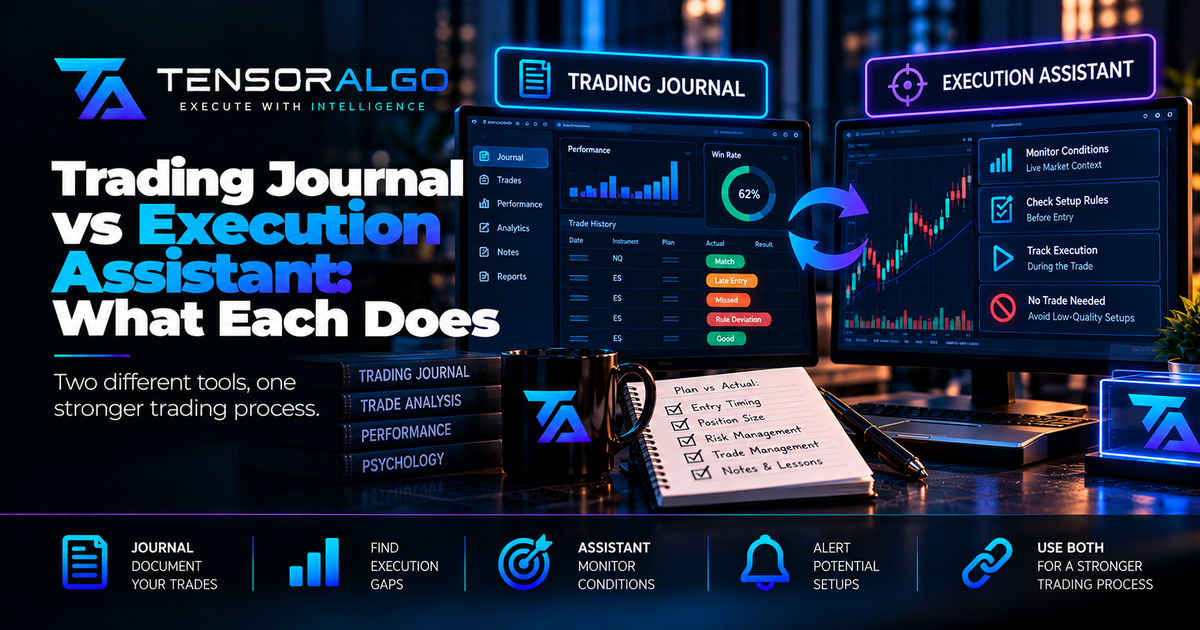
Trading journals document the gap between planned and actual trades; execution assistants monitor conditions before and during decisions. Learn how both tools work together without confusing alerts with verified fills.
Trading Journal vs Execution Assistant: What Each Does
A trading journal can show you what went wrong after the session. An execution assistant can help you notice a possible mistake before or during the trade. They are related, but they are not the same product and do not solve the same problem.
Developing traders often spend weeks refining journal spreadsheets, then continue to chase entries or skip qualified setups in real time. Others adopt alerts and AI tools, then struggle to evaluate their results because no trustworthy trade history exists.
The most useful approach is to understand what must be recorded, what can be monitored and what cannot be verified without execution data. This guide separates the roles and shows how to combine them without turning chart observations into invented financial performance.
The Job of a Trading Journal
A journal preserves evidence about decisions. It records which strategy was intended, when the setup appeared, the market context, planned entry, invalidation, size, actual execution and what happened afterward.
A basic log might record entry and exit prices. A more useful journal asks whether the setup qualified according to the rules, whether any condition was overridden and whether the trade matched the plan.
The CME trade-plan course includes a trade log alongside methodology, risk management and trading strategy. Logging is not an optional administrative extra if you want to distinguish strategy quality from execution quality.
A journal does not automatically prevent a rule violation. It makes that violation visible later when the records are accurate and complete.
The Job of an Execution Assistant
An execution assistant supports the workflow around a trade. It may monitor conditions, highlight an entry candidate, show whether confirmation is missing, remind the trader of risk boundaries or organize an outcome review.
It should not be confused with a trading bot that submits orders automatically. Some software may support execution integrations under separate permissions, but an informational signal or planned-trade card is not proof that a real order was accepted or filled.
A useful assistant tells the trader what it observed and what remains uncertain. It can reduce manual scanning, but it cannot guarantee fills, detect every setup or create profitable market conditions.
Its effectiveness must be measured against specific operational failures such as missed opportunities or repeated late entries, not against an invented universal win-rate improvement.
Before the Trade: Where an Assistant Can Help
Imagine a hypothetical NQ pullback strategy requiring directional context, a defined test of support, a confirmation candle and sufficient room to the first target. Those conditions can be monitored more consistently than a vague instruction to "buy strength."
An assistant may report that context qualifies but the trigger has not arrived. Or it may show that the opportunity expired after price moved beyond the allowable entry range.
The human still needs to understand the plan, data limitations, order type and acceptable risk. If the assistant's price feed is stale, even a correct condition check may be unusable for entry.
The Rule-Based Trading guide explains why explicit eligibility criteria are a prerequisite for meaningful monitoring.
During the Trade: Monitoring Does Not Mean Control
A position is live only when the appropriate execution records establish it. A trade assistant may display an entry plan, but an order may be pending, rejected, partially filled or not submitted at all.
During a position, software can support awareness of planned invalidation, protective orders and changes to market conditions. Yet if it cannot read an authoritative broker/exchange state, it should not invent position status.
A journal has a different job: preserve exactly which order or fill events were verified, what the trader changed and when. Quote movement is relevant market context, not an independent broker confirmation.
These distinctions become crucial when reconstructing trades from historical candles or trying to explain why a target appeared touched on one chart without a matching realized result.
After the Trade: The Journal Is the Source of Learning
At review time, a trader wants to know whether the strategy signal was valid, whether the entry was timely, whether the size matched the risk plan and how the trade ended after actual costs.
A journal stores that evidence. An assistant may help summarize and categorize it, but the model's explanation should link back to actual records rather than overwrite them.
Suppose the journal has a confirmed stop-out, while an AI summary confidently labels the same trade a win because price later moved through the target. The verified execution record takes precedence.
The Trading Journal Guide can help design fields for planned versus actual data. Keep every uncertainty visible when the underlying evidence is incomplete.
Why a Spreadsheet Alone Cannot Stop FOMO
A journal may reveal that you chased twelve late entries last month. That insight is helpful, but during the next fast candle the journal itself does not enforce the entry-expiry rule.
An assistant could help by marking the original opportunity as expired or showing that the remaining distance to target no longer compensates for planned risk. A deterministic check is often better than asking a language model to make up its own threshold.
The two tools therefore complement each other. The journal identifies a repeated mistake; the assistant may help make the rule visible when that mistake is likely to happen again.
Neither eliminates the trader's responsibility to decide whether to act or to respect account limits.
Why Alerts Alone Cannot Prove an Edge
An alert history tells you which conditions the monitoring software detected. It may not contain all unalerted qualifying setups, and it is not the same as verified fills or net account results.
To evaluate an alert system, record candidate timestamp, source, eligibility, expiry, later observations, user decision and execution status. Separate timely valid alerts from stale, duplicate or false-positive alerts.
A hypothetical signal that precedes a favorable move still requires realistic entry and exit assumptions. The NFA notice on hypothetical results warns about hindsight, liquidity and slippage issues that simulations cannot fully address.
Do not confuse a good-looking alert screenshot with evidence of realized profits or the usefulness of an entire strategy.
What Each Tool Should Record
A journal should preserve the strategy identifier and version, timestamp, instrument and contract, entry criteria, context, planned entry, stop, target, position size, actual fills and costs, deviations, reason for exit and result.
An assistant should record which rule was evaluated, which data source was used, whether the condition qualified, what was missing, what alert was issued and whether the candidate remained actionable.
Shared identifiers can connect the planned signal with the eventual journal record. But there must be a status for "no fill" and "outcome unverified" rather than forcing every signal into a completed trade.
The objective is traceable lineage from setup through action to result. A single number without its source is not a reliable performance metric.
Missed Opportunities Require Their Own Records
If you journal only trades that were taken, you cannot measure opportunities missed because you were distracted or unavailable. You also risk mislabeling deliberate no-trade choices as failures.
Record every eligible candidate when possible and classify its outcome: traded, skipped under risk policy, missed, expired or insufficient data. Avoid retrospective reclassification based on whether the later chart reached a target.
An assistant with good event logging can make these records easier to collect; a journal can make them easier to review. But if monitoring coverage is incomplete, be explicit about the denominator. You cannot calculate a reliable missed-setup percentage when you do not know how many valid candidates existed.
The Forward Testing Guide can help distinguish current-market observation from hindsight.
A Practical Risk Example
Suppose a hypothetical trader sets a maximum risk of $150 on a trade. The stop distance and the contract's verified point value determine the maximum contract quantity that fits the plan, before fees and slippage.
If a late entry doubles the stop distance, the same quantity would approximately double the gross risk. A journal will reveal the deviation after the event. A pre-trade assistant or deterministic risk check may help flag it before the order.
The Position Sizing Calculator Guide explains the sizing relationship, but tools still need correct contract specifications and prices.
Risk arithmetic is not a forecast. A stop may fill at a worse price in adverse conditions, so even a mechanically correct planned amount may differ from realized loss.
Data Quality Changes the Meaning of Both Tools
A beautiful journal can be wrong if the prices were mapped to the wrong contract, the timezone is shifted, the entry comes from a simulated order or a quote touch was mistaken for a real fill.
An assistant can be wrong for similar reasons. It may use a delayed proxy as a live futures price, or summarize a profile from the wrong session. Language quality does not repair those input problems.
Use timestamps with timezone, source identifiers and data freshness flags. Distinguish derived estimates from actual observations. Define reconciliation rules when multiple systems report different statuses.
Before studying performance, inspect missing values, duplicates, stale entries and unexplained mismatches. The quality of the dataset determines how trustworthy later conclusions can be.
Track Both Strategy and Execution Metrics
A journal can support net expectancy in R, distribution of outcomes, costs, drawdown, strategy version and performance by condition. An assistant can provide operational metrics such as timely-alert coverage, false positives, missed entries or time to recognition.
Keep these categories separate. A lower number of late entries is encouraging process evidence; it does not independently establish a profitable strategy. A strong backtest is encouraging signal evidence; it does not prove the live workflow can reproduce the fills.
A weekly dashboard should show the sample size, missing records, verified versus simulated outcomes and relevant caveats. Avoid comparing months with fundamentally different risk policies as if they were the same strategy.
For the broader economics, see What Makes a Trading Strategy Profitable?.
A Useful Daily Workflow
Before the session: review the active strategy version, approved instruments, maximum risk, data health and no-trade conditions. Verify that monitoring alerts are configured correctly.
During the session: observe only qualified candidates, note any stale or invalid data, and record deliberate skips with reasons. Do not turn every commentary update into a trade.
After the session: reconcile planned versus executed events, account for known costs, classify deviations and complete missing journal fields. Check that recorded P&L is supported by actual execution reports where required.
Weekly: compare strategy quality with execution quality. Decide whether to improve the entry monitoring, journal structure, risk control or underlying strategy. Avoid redesigning everything after a single loss.
What an AI Assistant Can Add to Review
AI can help summarize a week of structured events, find recurring categories of mistakes and draft explanatory notes. It may identify that most invalid entries happened after the first loss or that setup alerts often arrived too late to meet your own entry rule.
Those observations need source links and sufficient sample context. A pattern in ten trades is not proof of a universal psychological mechanism. Models can also misclassify records when fields are incomplete.
Treat generated review text as a hypothesis to check, not as an official ledger. Keep the original journal and broker data immutable or versioned, and document any corrections.
The most valuable automated review is one that makes evidence easier to inspect rather than one that produces the most confident narrative.
Where TensorAlgo Fits
TensorAlgo supports structured Playbooks, supported market monitoring and AI-assisted trading workflows. For a trader with clear rules, an assistant can help keep qualifying conditions visible while the journal remains the place to compare plan and actual outcomes.
The first Playbook support guide describes how to define your own strategy as a Playbook. The public marketplace is for discovering, renting, or buying eligible Playbooks created by others, not for editing your own.
Neither tool should imply guaranteed performance or infer confirmed executions from market prices alone. Check current Support Center documentation for exact capabilities, data coverage and account settings.
Frequently Asked Questions
Can an assistant replace a journal?
Not completely. Monitoring can create useful events, but a journal still needs trustworthy actual actions, results, risk and costs.
Is a trade alert proof that the strategy worked?
No. It is a notification about observed conditions; execution feasibility and realized outcomes require separate evidence.
Should I use both tools as a beginner?
Start with a simple written plan and reliable records. Add monitoring if it solves a measurable problem, not merely because it contains AI.
Can software prevent every late trade?
No. It can flag expiration or restrict some actions, but errors, overrides and missing inputs remain possible.
What should I improve first?
Identify whether your largest problem is inconsistent decisions, missed setups, unreliable data, risk deviations or genuinely weak net strategy performance.
A Side-by-Side Decision Example
Consider a hypothetical NQ short candidate. The trader's Playbook requires a failed breakout above a predefined resistance area, a return below that area and a specific confirmation trigger. Before price reaches the level, the assistant can show that the idea is only a possibility, not yet a qualified entry.
When the trigger appears, a monitoring tool can timestamp the candidate, identify the rule that fired and estimate the remaining distance from entry to invalidation using fresh prices. If the data feed disconnects, the system should record that the condition could not be reliably evaluated. No later candle should retroactively change that timestamped uncertainty into a valid trigger.
Suppose the trader places an order but the broker rejects it. The journal should record a qualified candidate and rejected order, not a profitable or losing filled position. If the market later moves to the proposed target, that may inform a hypothetical signal study, but it does not create realized P&L.
Now suppose the order fills, the trader changes the stop without a predefined reason and closes at a loss. The journal can record the actual fill and stop modification. An assistant can classify the departure from the Playbook and remind the trader of the original condition. It cannot truthfully tell the trader that an emotion caused the change without evidence.
This example demonstrates why candidate, order, fill, trade management and realized outcome are different states. Both tools become more useful when those transitions are recorded clearly and independently rather than flattened into one green or red result.
Final Takeaway
A trading journal and an execution assistant solve different parts of the same workflow. The journal preserves evidence about what was intended and what happened. The assistant can help monitor conditions and reveal problems before they become repeated decisions.
Used together, they can support a more measurable trading process—but neither creates a market edge or guarantees reliable executions.
Start with accurate records, explicit rules and trustworthy data. Then add software where it demonstrably reduces an operational problem without obscuring risk.