

What Is Copy Trading?
Copy trading can reduce real-time decision load, but it does not remove leverage, execution, or strategy risk. Learn how copying differs from signals and Playbooks, what can go wrong, and how beginners can evaluate it responsibly.
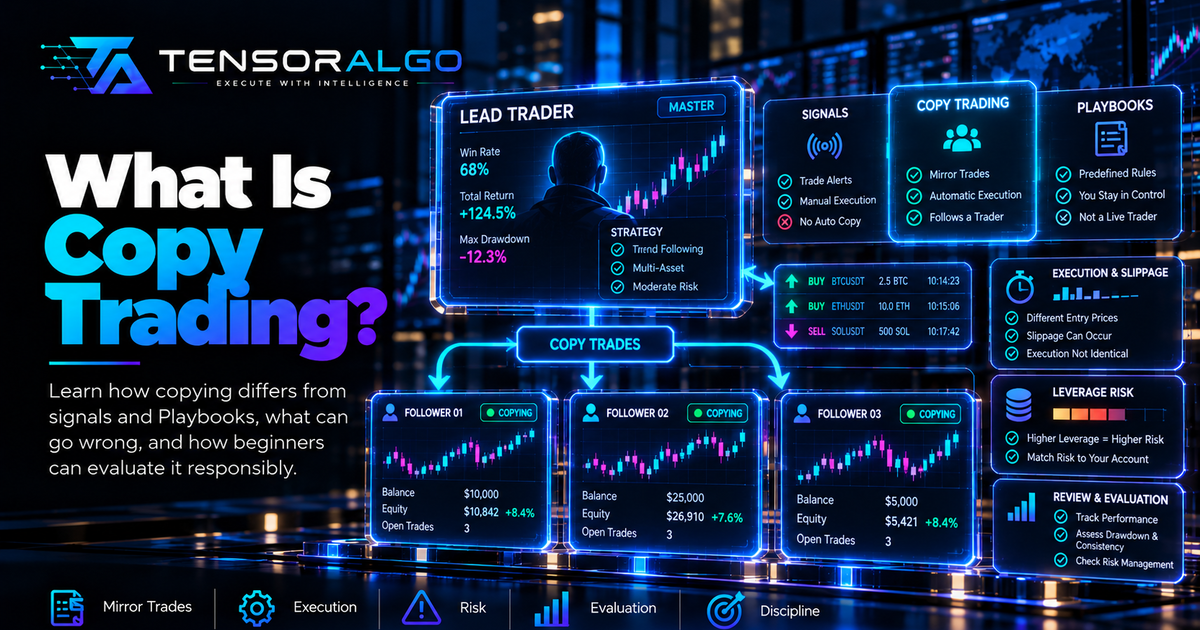
What Is Copy Trading? How It Works, the Risks, and What Beginners Should Know
Copy trading is a way of following another trader’s activity by automatically or semi-automatically replicating their trades in your own account. The idea is simple: instead of deciding on every entry and exit yourself, you choose a trader, strategy, or model to follow and allow their actions to influence your own positions.
That simplicity is exactly why copy trading attracts beginners. It can feel like a shortcut around the hardest parts of trading: finding a strategy, deciding when to enter, managing uncertainty, and controlling emotions.
But copy trading does not remove market risk. It also introduces several risks that are easy to underestimate: choosing the wrong person to follow, copying a strategy you do not understand, using different position sizes, experiencing worse fills, and continuing to follow a trader after their behavior changes.
The most useful way to think about copy trading is not “someone else trades for me.” It is “I am outsourcing part of the decision process, while the financial consequences still belong to me.”
Educational information only. Trading futures, forex, options, and other leveraged products involves substantial risk. Copying another trader does not guarantee similar results.
What Does Copy Trading Mean?
In a typical copy-trading setup, one account acts as the source and another account follows it.
Depending on the platform, the follower may copy:
- entries;
- exits;
- stop-loss or take-profit orders;
- position size;
- changes to a position;
- specific instruments;
- only trades that meet certain follower settings.
Some systems copy trades proportionally. If the source trader risks a certain percentage of their account, the follower’s position may be scaled to their own balance. Other systems use fixed quantities or custom multipliers.
There is no universal implementation. That matters because two platforms can both use the label “copy trading” while handling position sizing, partial fills, stop orders, latency, and unsupported instruments differently.
Before using any copy-trading service, understand exactly what gets copied and what does not.
Copy Trading vs Trading Signals
Copy trading and trading signals are related, but they are not the same.
A trading signal tells you that someone believes a trade may be worth considering. It might include a market, direction, entry, stop, and target. You still decide whether to act.
Copy trading usually goes one step further. The source trader’s action can be mirrored automatically or with minimal intervention.
This creates a different responsibility profile.
With a signal, the main risk is that you follow poor analysis or act inconsistently.
With copy trading, you add operational risk. The copying system can fail, position sizes can be wrong, orders can be delayed, or the source trader can change behavior before you notice.
The CFTC warns traders to be cautious of anonymous social-media “experts,” trade-signal sellers, and claims involving secret or failsafe strategies. That warning is especially relevant when a beginner is tempted to treat someone else’s trade as proof rather than as an uncertain decision.
For a deeper look at the behavioral side of following outside opinions under pressure, see Trading Psychology.
Copy Trading vs Following a Trading Playbook
There is another model that beginners often confuse with copy trading: following a structured trading playbook.
A trading playbook does not have to tell you “buy now” or automatically copy another trader’s order. Instead, it defines the process behind a setup:
- when the setup is eligible;
- what market context matters;
- what confirms the trade;
- where the trade is invalidated;
- how risk is calculated;
- how the position is managed;
- when the setup should be skipped.
That distinction matters.
Copy trading transfers more of the real-time decision to the source trader.
A playbook transfers structure, not necessarily the live decision.
That can be useful for beginners who want to learn why a trade qualifies instead of only seeing the final entry and exit.
TensorAlgo’s Playbooks Marketplace is a public catalogue where users can discover, rent, or buy Playbooks created by other users. A marketplace Playbook is not the same thing as an automatic copy-trading connection.
Creating your own Playbook is a separate workflow. The first Playbook guide explains how to define your own setup and rules.
Why Beginners Are Attracted to Copy Trading
Most new traders do not begin with a tested process.
They begin with uncertainty.
They do not know:
- which market to trade;
- which strategy to trust;
- how much to risk;
- when to enter;
- when to stop;
- whether a losing streak means the strategy is broken;
- whether a winning streak means they found an edge.
Copy trading appears to solve all of that instantly.
You find someone with an attractive track record, press follow, and let the system do the rest.
The problem is that a performance chart is not the same thing as understanding the underlying risk.
A trader may have strong recent returns because they use:
- larger position sizes;
- a strategy that benefits from one recent regime;
- averaging down;
- wide or hidden stops;
- correlated positions;
- leverage that produces severe tail risk;
- a short sample with unusually favorable outcomes.
A beginner looking only at total return may miss all of those details.
The Biggest Risk: You May Not Understand What You Are Copying
Suppose a source trader has a 70% win rate.
That sounds attractive.
But what if the average winner is small and the average loser is five times larger?
What if the strategy has not yet experienced a normal losing streak?
What if the trader adds to losing positions?
What if they hold through major events while you assumed positions were intraday only?
The headline statistic does not tell you the behavior of the strategy.
This is why What Makes a Trading Strategy Profitable? emphasizes expectancy, payoff, costs, drawdown, robustness, and unseen evidence rather than one metric such as win rate.
If you cannot explain how the strategy makes and loses money, you are not only copying trades. You are accepting risks you may not recognize.
Performance Can Differ Between the Source and the Follower
Even when the source trader is legitimate and the platform works correctly, your result may differ.
Position sizing differences
If the source account is larger, smaller, or uses different leverage, your copied quantity may not create the same percentage risk.
Slippage
The source trader may be filled at one price and followers at another. During fast markets, a small difference can materially change a short-duration trade.
Latency
Copying is not instantaneous in every system. A trade can move before the follower’s order reaches the market.
Partial fills
The source may receive a complete fill while the follower receives only part of the intended quantity.
Account restrictions
Different brokers, jurisdictions, margin settings, or permitted products can change what can be copied.
Minimum trade size
If proportional sizing produces less than the platform’s minimum quantity, the follower may skip the trade or round the position.
Those differences are one reason a copied performance history should never be treated as a promise of identical future results.
Copy Trading Does Not Remove Leverage Risk
This point is especially important in futures.
NFA investor guidance warns that futures are highly volatile and risky and that leverage can create profit-and-loss fluctuations larger than many other forms of investment activity. The CFTC’s futures-market education also warns that futures traders can lose all of the money in an account and, in some circumstances, more than they initially committed.
Copying a disciplined trader does not change those mechanics.
If the copied position is too large for your account, the trade can still be inappropriate for you.
That is why your own risk limits should exist independently of the source trader.
Before copying any position, know:
- the maximum quantity you will allow;
- the maximum dollar risk per trade;
- the maximum daily loss;
- the maximum combined exposure;
- which markets may be copied;
- what happens if the source trader increases size;
- what happens if the copy connection fails.
Our Futures Risk Management Guide and Position Sizing Calculator Guide explain the arithmetic behind those controls.
Track Record Risk: What Does the Performance Actually Represent?
A copy-trading profile often shows some combination of:
- total return;
- win rate;
- number of followers;
- drawdown;
- trade count;
- risk score;
- months active;
- average holding period.
Those fields are useful only if you understand how they are calculated.
Ask:
- Is the track record live or simulated?
- Does it include fees?
- Does it include unrealized losses?
- Is the drawdown based on balance or equity?
- How long is the record?
- How many trades does it contain?
- Are results concentrated in one market?
- Has the trader changed strategy?
- Are deposits or withdrawals affecting the return calculation?
- Can the history be independently verified?
A three-month record can look excellent and still be statistically weak.
A long record can also be misleading if the strategy changed halfway through.
Treat the profile as evidence to investigate, not proof.
Strategy Drift
One of the most overlooked copy-trading risks is that the source trader can change.
A trader may begin with small, rule-based intraday positions and later:
- increase leverage;
- change instruments;
- hold overnight;
- trade news;
- average into losses;
- start taking more frequent trades.
If the follower assumes the original behavior remains unchanged, risk can rise without an explicit decision.
This is similar to strategy versioning in a professional trading process. When important rules change, the strategy should effectively be treated as a new version.
The Rule-Based Trading guide explains why explicit rules and versioning matter even when a human remains involved in decisions.
Social Proof Can Be Dangerous
Copy-trading platforms naturally make popularity visible.
You may see:
- follower counts;
- leaderboards;
- recent returns;
- badges;
- comments;
- screenshots;
- testimonials.
Social proof can make a strategy feel safer than it is.
The CFTC’s social-media fraud advisory specifically warns about fake testimonials, unregistered advisers, and so-called trading experts on social media. A large audience does not verify a strategy’s edge, risk controls, or legal status.
Before following anyone, check whether the person or entity should be registered for the service they provide in the relevant jurisdiction. In the United States, NFA BASIC is one resource for checking the registration and background information of certain futures-industry firms and professionals.
Do not assume that a social-media profile or platform badge replaces due diligence.
Can Copy Trading Help You Learn?
It can—but only if you deliberately use it that way.
Passive copying often teaches very little.
You see the trade, but you may not know:
- why the setup qualified;
- what invalidated it;
- why the stop was there;
- whether the trader considered other opportunities;
- which trades they intentionally skipped;
- which market conditions make the setup weak.
If the goal is learning, build a review process around every copied trade.
For each one, record:
- the setup;
- market context;
- entry;
- stop;
- target;
- risk;
- result in R;
- whether you understood the reason for the trade;
- what you would have done without the source trader.
A Trading Journal can help separate what you observed from what you actually understood.
Over time, the objective should be to reduce dependence on unexplained decisions.
A Safer Way to Evaluate Copy Trading
Instead of asking “Who has the highest return?”, use a checklist.
1. Understand the strategy
Can you explain in plain language how the trader is trying to make money?
2. Understand the risk
What is the normal stop, drawdown, and worst historical losing sequence?
3. Check the record
How long has the trader been active and how many trades are represented?
4. Check for leverage
How large are positions relative to the account?
5. Check strategy consistency
Has the trader materially changed markets, timeframes, or risk?
6. Check the platform mechanics
How are sizing, latency, partial fills, disconnects, and unsupported instruments handled?
7. Apply your own limits
Never allow the source trader’s risk settings to become your risk policy by default.
8. Start in observation or simulation when possible
Watch how the strategy behaves through normal wins and losses before increasing exposure.
9. Review the copied trades
Do not let automation become a reason to stop paying attention.
10. Know how to stop
Understand how to disable copying, cancel orders, and verify open positions if the connection fails.
Copy Trading vs Learning to Trade Yourself
The trade-off is not as simple as “easy versus hard.”
Copy trading can reduce the number of real-time decisions you make, but it increases dependence on:
- the source trader;
- the platform;
- the copying logic;
- the source trader’s future behavior.
Learning to trade yourself requires more work, but it gives you more direct understanding of the decision process.
For many beginners, a hybrid approach makes more sense: study structured strategies, observe experienced traders, use simulation, and gradually learn to make your own decisions rather than turning off your judgment completely.
If you want to move from observation toward a process you can evaluate yourself, Why You Need a Trading Playbook is a practical next step.
Where TensorAlgo Fits
TensorAlgo is not built around the promise that beginners should blindly mirror another person’s trades.
The more durable idea is to make the strategy and decision process visible.
Through structured Playbooks, market context, risk rules, and post-trade review, traders can work from a repeatable framework rather than treating every alert as an unexplained command.
Beginners who do not yet have their own strategy can use TensorAlgo to study structured Playbooks and the decision logic around them. The goal should be to understand the setup, the conditions, and the risk—not simply to outsource responsibility.
From there, use the existing Playbook and risk-management resources to turn observations into rules you can explain and review.
Frequently Asked Questions
Is copy trading the same as automated trading?
Not necessarily. Copy trading mirrors another trader or strategy source. Automated trading can execute your own predefined strategy rules without copying another person.
Is copy trading good for beginners?
It can reduce decision load, but it can also hide risk and slow learning if the beginner does not understand the strategy. Treat it as a tool, not a guarantee.
Can I lose money with copy trading?
Yes. The source trader can lose, your copied fills can differ, position sizing can be inappropriate, and leverage can magnify losses.
Will my results match the trader I copy?
Not necessarily. Differences in account size, sizing rules, slippage, latency, fees, and execution can create different results.
How do I choose someone to copy?
Look beyond return. Review strategy behavior, drawdown, leverage, trade count, consistency, time in the market, platform mechanics, and whether the record is verifiable.
Is following a Playbook the same as copy trading?
No. A Playbook defines a structured trading process. It can help you understand when and why a setup qualifies without automatically mirroring another trader’s brokerage orders.
Final Takeaway
Copy trading can make trading look easier because it moves many decisions to someone else. But it does not transfer the financial responsibility.
The source trader can be wrong. The strategy can change. Execution can differ. Leverage can still hurt. A strong recent track record can still fail.
If you use copy trading, treat it as a system that must be understood, bounded, and reviewed. Apply your own risk limits, verify what the platform actually does, and learn enough about the strategy that you can recognize when its behavior changes.
The goal should not be to find someone you never have to question.
The goal should be to build enough structure and understanding that every trade—copied or not—fits a process you can explain.