
From Noise to Process: Why We Built TensorAlgo
Trading produces endless data. The hard part is turning it into a repeatable decision process. Here’s why we built TensorAlgo — and what we believe modern trading software should actually do.
From Noise to Process: Why We Built TensorAlgo
Trading has never suffered from a shortage of information.
Charts. Indicators. Order flow. Gamma levels. Economic releases. Volume profiles. Market structure. News. Social media. Screenshots. Journals. Statistics.
The modern trader can see more data than ever before.
And yet one of the hardest problems in trading remains exactly the same:
How do you turn all of that information into a process you can actually follow?
That question is at the heart of why we built TensorAlgo.
TensorAlgo is not intended to be another screen filled with indicators. It is being built as a trading intelligence platform — a place where market context, trading plans, execution history and post-trade analysis can work together instead of living in separate tools.
As we prepare for the public launch of TensorAlgo, we wanted our first article to explain the thinking behind the platform.
Trading Doesn't Need More Noise
Most traders eventually accumulate a collection of tools.
One platform for charts. Another for order flow. A spreadsheet for statistics. Screenshots stored somewhere else. Notes in a journal. A few indicators that were useful last month. Maybe a document containing trading rules that hasn't been opened for weeks.
Individually, many of those tools are useful.
The problem is that they rarely form a system.
A trader can have excellent information and still make inconsistent decisions.
You can know where an important level is and still chase price.
You can have a clearly defined stop loss and still move it.
You can understand that a setup performs poorly during certain market conditions and still trade it because the chart looks good right now.
The gap between knowing and executing is where a huge part of trading happens.
TensorAlgo is being designed around that gap.
Better trading is not necessarily about finding more information. It is about making better use of the information you already have.
A Playbook Should Be More Than a Setup Name
Traders often talk about having a playbook.
But a playbook can mean very different things.
For one trader, it might simply be:
VWAP Reclaim
For another, it might include entry rules, invalidation, market context, expected risk-to-reward, session conditions, confirmation signals and execution rules.
We believe the second version is much more useful.
A TensorAlgo Playbook is designed to help turn an idea into something that can actually be evaluated.
Instead of remembering a strategy differently every time you trade it, you can define the logic around it and create a repeatable framework.
That matters because consistency creates something extremely valuable:
data you can trust.
If the rules change every day, the results are difficult to interpret.
If the process becomes more consistent, patterns begin to emerge.
Your Trading History Should Teach You Something
Most trading journals answer a basic question:
What happened?
We want TensorAlgo to help answer the next questions:
Why did it happen?
What keeps happening?
Under which conditions does this setup perform best?
Where does execution begin to break down?
What should I focus on next?
That is the purpose behind the Trade Intelligence Center.
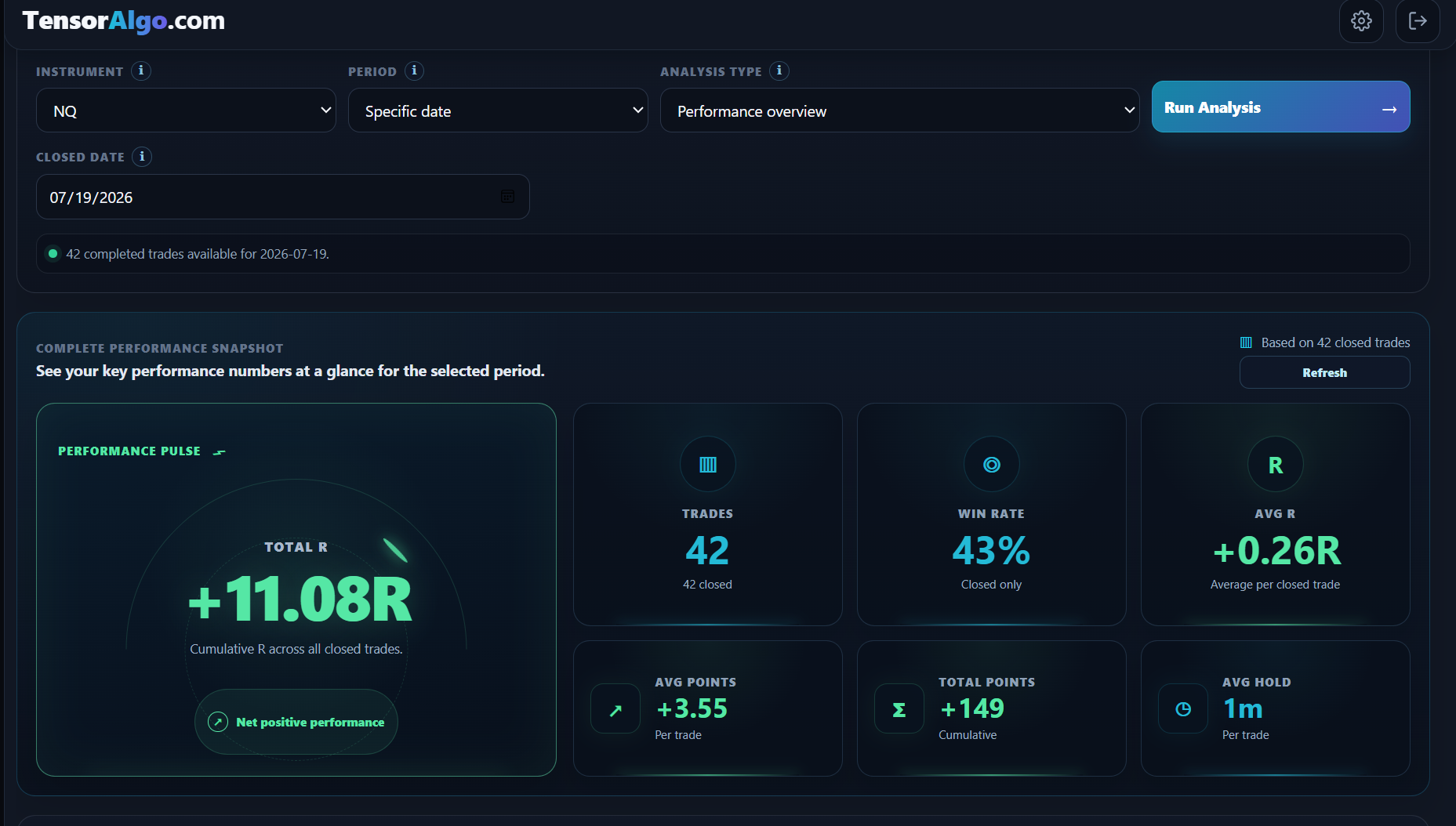
Rather than treating closed trades as rows in a database, TensorAlgo can use trading history as material for deeper analysis.
Imagine reviewing a group of trades and discovering that your strategy itself is performing well, but most of your losses occur after two consecutive losing trades.
Or discovering that your strongest setup performs significantly better during a particular session.
Or that trades taken against a certain market regime consistently underperform.
Those insights are much more actionable than simply seeing a win rate.
Statistics describe the past. Trading intelligence should help improve the next decision.
AI Should Support the Trader, Not Replace the Trader
Artificial intelligence is becoming part of almost every category of software.
Trading is no exception.
But we believe there is an important distinction between using AI to support decision-making and asking AI to make every decision for you.
TensorAlgo is being built primarily for traders who still want to think, evaluate and execute.
AI can help structure a trading idea.
AI can analyze a group of trades.
AI can identify behavioral patterns that are difficult to notice manually.
AI can help turn loosely defined rules into a structured Playbook.
But the trader remains responsible for the process.
That is intentional.
Our goal is not to create a button that promises effortless trading.
Our goal is to build tools that help serious traders become more systematic.
Market Context Matters
A setup rarely exists in isolation.
The same price pattern can behave very differently depending on volatility, liquidity, positioning, session structure and the broader market environment.
That is why TensorAlgo combines strategy tools with market context.
For supported markets, the platform can bring together information such as gamma positioning, important levels, dealer regime, volatility context and other market-state observations.
The purpose is not to overwhelm traders with another collection of numbers.
The purpose is to help answer a more useful question:
What kind of environment am I trading in right now?
An aggressive breakout strategy may behave very differently during compression than during expansion.
A mean-reversion setup may perform differently around major positioning levels.
A setup that works beautifully during one part of the session may degrade somewhere else.
Context allows a Playbook to become more than:
“When X happens, buy.”
It can become:
“When X happens, under conditions Y and Z, this is a setup I am interested in.”
That difference is small in wording and enormous in practice.
The Three Parts of the TensorAlgo Process
Ultimately, we think a useful trading platform should help traders connect three things:
- Prepare. Define the setups, conditions and risk rules you actually want to trade. Build Playbooks instead of relying on memory and improvisation.
- Execute. Use market context and your own rules to make more deliberate decisions during the trading session.
- Review. Analyze completed trades, identify recurring strengths and weaknesses, and feed those insights back into the Playbook.
That creates a loop.
Prepare → Execute → Review → Improve
Then repeat.
The software should support that loop rather than distracting from it.
Trading Psychology Is Part of the System
Many trading tools focus almost entirely on market analysis.
But traders don't execute strategies in a vacuum.
They execute them while experiencing uncertainty, losses, missed trades, winning streaks, hesitation, fear of giving back profits and the temptation to abandon rules.
That means psychology cannot really be separated from execution.
One reason structured Playbooks matter is that they create a reference point.
When the market becomes fast, you don't have to invent your process again.
You already decided what qualifies as a trade.
You already decided what invalidates it.
You already decided how much risk belongs to it.
The challenge becomes following the process.
That makes post-trade review much more meaningful too.
Instead of asking:
“Why did I lose?”
you can ask:
Did I execute the Playbook correctly?
Those are very different questions.
A good trade can lose.
A bad trade can win.
The long-term objective is not to judge every decision by its immediate P&L.
It is to build a process where good decisions become increasingly repeatable.
Built for Traders Who Want to Improve Their Process
TensorAlgo will not be for everyone.
If you're looking for software that tells you exactly when to buy and sell while removing all responsibility from the trader, this probably isn't what you're looking for.
TensorAlgo is being built for traders who want to understand their own trading more deeply.
Traders who create setups.
Traders who test ideas.
Traders who review mistakes.
Traders who care about execution quality.
Traders who believe the goal is not to predict every market move, but to develop a process that can survive uncertainty.
That is the type of trading we want the platform to encourage.
And We're Just Getting Started
TensorAlgo is currently in pre-launch, and the platform has already evolved far beyond the original idea that started it.
What began as a collection of tools for analyzing futures trading has grown into a broader system around Playbooks, market intelligence, performance analysis, trading psychology and AI-assisted review.
And there is much more we want to build.
But there is one principle we want to preserve as the platform grows:
Every feature should help the trader make the process clearer — not make the screen noisier.
Our public launch is the beginning of that next phase.
If you're already part of the TensorAlgo pre-launch community, thank you for helping us test, challenge and improve the platform.
And if you're discovering TensorAlgo for the first time, welcome.
We look forward to showing you what comes next.
Build the Playbook. Follow the process. Learn from the data.