

Sell Trading Knowledge Without Giving Signals
Trading creators can sell courses, structured Playbooks, exercises, and educational communities without promising live signals. Learn how to package useful skills with transparent evidence and realistic business boundaries.
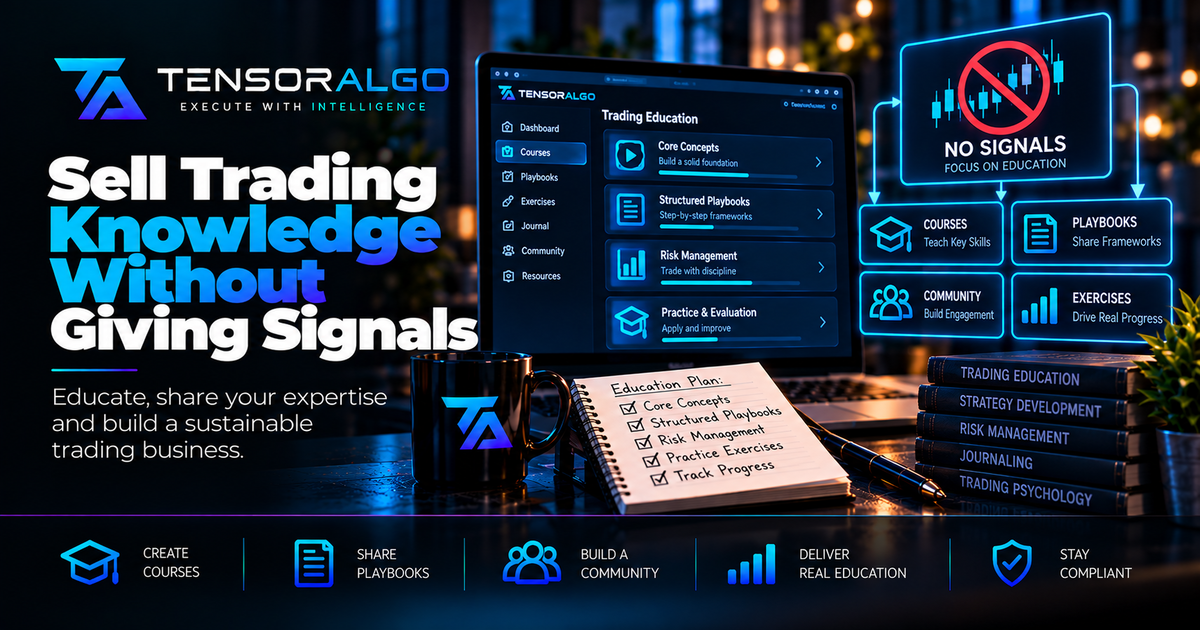
Sell Trading Knowledge Without Giving Signals
Creators often begin by posting charts. A follower eventually asks the question that changes the relationship: "Can you tell me exactly when to buy or sell?" It can sound like the easiest way to monetize an audience. But a live-signal operation requires availability, reliable delivery, constant clarification and careful attention to what the service actually represents.
There is another route: sell knowledge, method and structured practice instead of promises about specific future trades. This can include courses, practical workshops, strategy frameworks, journals, review sessions and eligible strategy Playbooks.
Avoid false comfort, though. A product can still raise regulatory or consumer-protection questions depending on the activity, instrument, location and way it is marketed. "Education only" is not a universal exemption. The goal is transparent value, not clever wording around responsibilities.
Teaching the Process Is a Different Product
A signal says something like "enter here with this stop." A lesson explains how a trader evaluates conditions, why certain setups qualify and what invalidates the analysis. An educational product should build the learner's independent understanding, not only create dependence on the creator's next message.
For example, you might teach how a VWAP pullback differs between a balanced and a directional session. Include the prerequisites, counterexamples and failure conditions. Ask the student to classify new charts without seeing the next twenty candles.
That is an observable learning outcome: can the student apply the stated process? The outcome is not a guarantee that they will make money. A clearly framed product makes it easier to deliver useful value while keeping the learner's decisions their own.
Start With One Teachable Strategy
A creator who knows many setups may be tempted to sell a large library immediately. A better first product often has one well-documented method with limited conditions and a logical teaching progression.
Specify instruments, timeframes, sessions, context, entry and invalidation, risk assumptions, common near misses and no-trade rules. Then provide valid and invalid historical examples with contemporaneous conditions identified.
If the strategy depends heavily on personal discretion, explain that rather than pretending it is fully mechanical. Different people can interpret order blocks or liquidity structures differently. Define the observations your method actually uses.
The Rule-Based Trading guide is a useful foundation for turning a broad market idea into a repeatable exercise.
Build Practice Instead of Constant Alerts
Give learners work they can do independent of your calendar. For a market-structure lesson, provide labeled and unlabeled examples, then ask students to write why a candidate qualified or did not qualify.
For a risk lesson, ask them to calculate how stop distance and contract value affect quantity. For an execution lesson, ask them to identify when a price move has already traveled beyond the permitted zone.
Feedback should address reasoning and process errors, not reward students simply because a hypothetical trade happened to win. The Trading Journal Guide supports recording plan versus action.
A course becomes more valuable when students can demonstrate comprehension, not merely watch hours of video.
Explain Why a Setup Can Lose Even When It Qualifies
If an educator shows only winners, students may infer that recognizing the pattern should consistently generate profit. Markets are uncertain and a qualified setup can still produce a loss.
Include examples where the trader followed the rules but the market reversed. Discuss stop placement, normal adverse movement, order execution costs and why a loss does not automatically invalidate a strategy. Conversely, a lucky winner outside the rules is not proof of process quality.
The CFTC's checklist before trading emphasizes understanding losses, fees and risk. A responsible course teaches these constraints alongside the chart technique.
Transparent losing examples support better independent judgment and reduce the pressure to provide certainty you cannot honestly promise.
Offer Structured Reviews Rather Than Personal Trade Calls
Educational group sessions can review the quality of documented reasoning: Was the intended setup clearly defined? Which evidence was visible at the decision point? Was the risk calculation consistent? How did the participant record the outcome?
Avoid turning every review into a personalized live instruction disguised as a lesson. The line between education and recommendations depends on real conduct, the people involved and applicable law—not merely on using the word "workshop."
For services that might touch individualized investment or commodity-trading advice, obtain qualified legal guidance for the relevant jurisdictions and activities. A creator's reputation is not a regulatory authorization.
Good learning design makes the process reproducible without relying on the educator to make every decision.
A Better Content Product: The Playbook Package
An educational Playbook package can include a conceptual explanation, precise eligibility checklist, entry/exit examples, risk worksheet, counterexamples, glossary and a structured journal template. Buyers know what they can practice.
A software Playbook may also organize supported monitoring conditions. On TensorAlgo, the first-Playbook creation guide is relevant for building your own rules.
The public marketplace is a separate catalogue where users discover, rent, or buy eligible Playbooks created by other users. Do not confuse publishing an original strategy under platform rules with copying or reselling a third party's content.
Rights, access duration, eligibility and support should be explained before any purchase. Product organization is valuable even when no live signal is offered.
Design Lessons for Different Skill Levels
A novice needs to understand instruments, tick values, leverage and stops before interpreting subtle entry concepts. A developing trader may already know the terminology but struggle to follow it consistently in a live session.
Separate introductory and advanced prerequisites. A course marketed to funded futures traders should not spend most of its time repeating generic definitions; an introductory course should not start with complex order-flow examples without explaining the basics.
State the intended audience honestly. Give students a self-assessment to identify when they need additional fundamentals. The Futures Trading Glossary can be a useful reference, but a glossary alone is not a complete curriculum.
A clear learning path reduces both refund requests and the temptation to provide improvised individual trade calls.
Choose an Offer That Matches the Ongoing Work
A one-time course may fit material that changes slowly and requires limited ongoing access. A membership may fit a recurring educational workshop, continuing updates and community review. Group coaching may make sense when students need structured feedback.
Each model creates a different workload. If you sell live sessions, people will reasonably expect the sessions to happen. If you sell periodic updates, you need a defined maintenance policy. If you offer lifetime access, explain whether it covers future versions or only existing materials.
Do not describe every model as passive income. Videos need corrections, new learners need onboarding, and even self-serve products can produce support requests.
Choose the format that best helps students learn the skill—not the payment model with the most exciting screenshot.
Show Evidence Honestly
Historical trade examples can teach a method, but they should not be presented as independently verified financial results unless that is true. Label hypothetical, backtested, simulated, forward-shadow and confirmed execution records separately.
Disclose the historical period, underlying instrument, transaction-cost assumptions and any meaningful dataset limitations. Avoid selecting a handful of spectacular winners to imply that a learner is likely to reproduce them.
The NFA interpretive notice on hypothetical results explains important differences between simulated figures and real trading, including hindsight and slippage. Specific compliance obligations depend on regulated status and promotional use.
When evidence is incomplete, say so. This is a strength for an educator, not a reason to invent certainty.
Marketing That Does Not Depend on Income Promises
You can market the depth of a course, the clarity of its checklists, annotated examples, instructor experience that can be substantiated, or a well-designed learning community.
Do not promise that the product will enable every buyer to pass a prop-firm challenge, achieve a target win rate, or replace a salary. Testimonials should be representative and presented within the applicable rules; dramatic isolated results do not establish expected performance.
A landing page should answer: Who is this for? What will they learn? What prior knowledge is required? What material will they receive? How is support handled? What are the limitations?
The How to Choose a Trading Strategy guide can help readers assess whether a particular method fits their own objectives.
Affiliate Income Is a Separate Disclosure Issue
Some educators partner with charting providers, broker-adjacent software companies or other trading services. When a creator has a financial or other meaningful relationship with a recommended brand, followers should be able to understand that relationship.
The FTC's influencer disclosure guide explains material connections and the need for clear disclosure where applicable. A vague note buried in the profile may not be enough.
Do not recommend a product solely because of commission, claim features you have not verified, or imply that a paid tool guarantees trading success. Affiliations, educational course sales and creator marketplace earnings are different revenue streams.
Treat audience trust as a long-term responsibility rather than an expendable conversion tactic.
Guardrails for a Creator Community
If you host a Discord or Telegram space, set rules about false identity, unsolicited direct messages, account screenshots, unauthorized payment collection and the distinction between official lessons and peer speculation.
Teach students not to copy an unknown person's positions solely because they see a winning screenshot. Encourage questions about entry qualification, uncertainty, risk and what data would change the interpretation.
Moderation and customer support take time. Establish a way to report problems, clarify course materials and correct errors publicly. Avoid creating the impression that every channel post has been reviewed or endorsed by the educator.
A smaller community with visible standards may be more useful for learning than an enormous feed of unmanaged signals.
Protect Original Work Without Misleading Buyers
Organize your course files, version your curriculum and clarify the license granted to students. A buyer should understand whether they may use worksheets personally, redistribute templates, or embed a method in a separate service.
You can keep proprietary implementation details private while describing the learning outcomes and scope honestly. Do not claim a method is impossible to copy or that a broad trading pattern belongs exclusively to you.
If your work includes software settings, platform access or third-party data, respect those licenses and ensure the product's terms match the rights you actually control. For complex licensing, professional legal advice may be necessary.
Good documentation protects creator and buyer because it avoids ambiguity about what was purchased.
Build a Small Pilot Before a Big Launch
Create one complete sample lesson and one practical exercise. Invite a limited group to attempt the work without your live guidance. Record where instructions were unclear, which examples confused learners and how long the work realistically took.
Revise the material from feedback. Then test the actual payment and onboarding path, cancellation policy if relevant, support expectations, and whether each claim on the landing page matches a deliverable.
Do not infer financial demand from social media likes. Real willingness to pay and actual course completion provide different, useful signals. Both are more concrete than follower count alone.
A pilot can validate product usability but cannot guarantee growth, recurring income or student trading performance.
Where TensorAlgo Fits
TensorAlgo can support the move from undocumented market ideas to user-defined Playbooks and monitoring workflows. It can also provide marketplace access for eligible creator-owned Playbooks under current platform terms.
A creator should distinguish a Playbook's documented rules from any claim that it will produce profits for customers. Explain platform permissions, supported instruments, risk limits and any buyer eligibility requirement precisely. The Support Center provides current product details.
The educational opportunity is to help learners understand why a setup qualifies, when it does not and how to review decisions. Software can organize this process; it should not replace a learner's independent responsibility for trading risk.
Frequently Asked Questions
Can I sell trading education without a signal room?
Yes. Courses, examples, structured Playbooks, exercises, group learning and journals can provide practical educational value.
Is "not financial advice" enough to make any service unregulated?
No. The nature of actual activities, compensation and applicable jurisdictions matters. Seek qualified advice for your business model.
Will students pay without real-time entries?
Some audiences may value a clear process and feedback. Validate real demand with a small, honest offer rather than assuming universal preferences.
Can I use my historical winning trades to market the course?
You can use examples with accurate context, but do not imply a few selected winners establish typical future outcomes. Label hypothetical and actual results correctly.
What should the first product include?
One narrow teaching objective, prerequisites, a clear process, valid and invalid examples, risk lessons, practice tasks, and explicit support and access terms.
A Sample Four-Module Curriculum
A practical course can show the difference between teaching a method and handing out entries. Consider a hypothetical four-module program built around a single futures pullback strategy.
Module one: understand the market. Explain the contract, trading hours, tick and point values, session conditions and the common reasons a pullback can fail. Give students a short comprehension test before they move to advanced material. Students should be able to explain how a stop distance becomes a dollar amount without being told what quantity to trade.
Module two: recognize the setup. Define context, the trigger, invalidation and expiry. Show qualified examples alongside tempting false signals. Hide the later outcome during practice so students classify the information that was available at the time.
Module three: plan risk and execution. Ask students to calculate position size under a hypothetical risk cap, describe a valid no-trade decision and explain why chasing a missed entry changes risk/reward. Compare the proposed plan with a documented simulated execution, including possible fees and slippage.
Module four: review and refine. Have students prepare a short journal with valid, invalid and missed opportunities. Ask them to separate process quality from trading outcomes. One compliant losing trade is a useful case study; one impulsive winner should not become an endorsed example of discipline.
The instructor can offer feedback on how well the exercise follows the curriculum while avoiding a promise about the student's future results. This program is an illustration of educational design, not a claim that four modules make someone profitable. Expand or adapt the modules only when student feedback shows a genuine need rather than to make the course catalogue look larger.
Final Takeaway
Selling trading knowledge does not require turning an audience into a room of people waiting for your next buy or sell instruction. A structured education product can teach learners to interpret markets, define rules, manage risk and review decisions independently.
Focus on useful skills, candid limitations, trustworthy evidence and transparent business terms. Avoid guarantees and verify obligations before offering regulated activities.
That creates a product whose value comes from a process people can understand—not the illusion that a creator can predict every trade.