

The Truth About Trading Signals
A trading signal is an instruction, not a complete trading system. Without context, invalidation, sizing, costs and a transparent record, a buy or sell alert can create more dependency than skill.
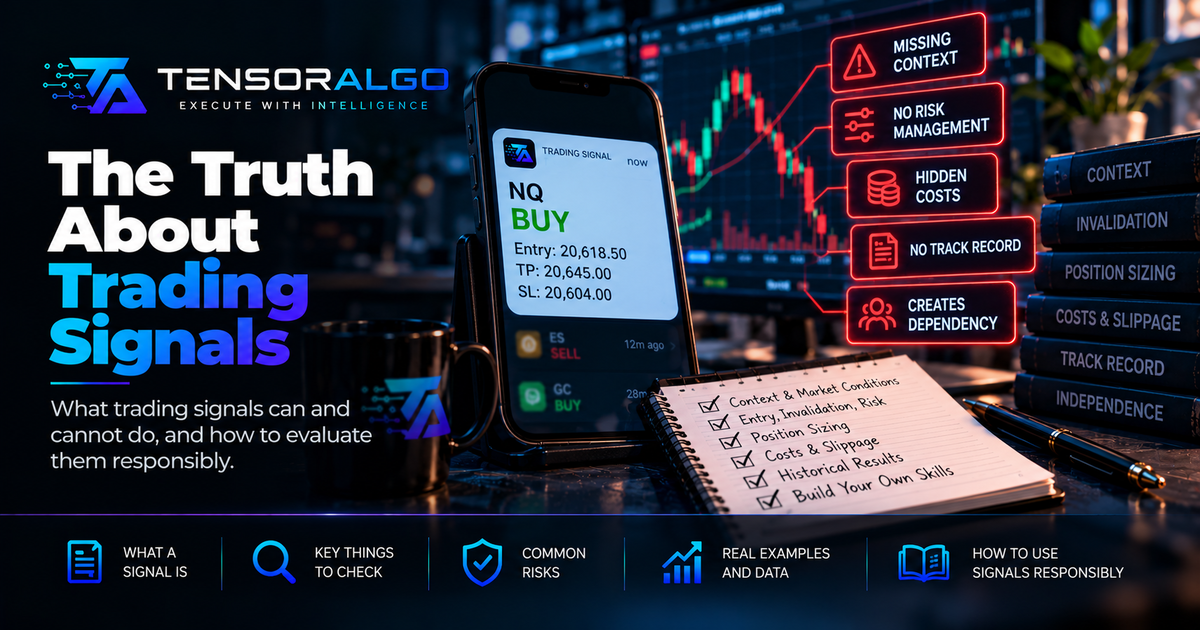
Trading signals are attractive because they appear to solve the hardest part of trading: deciding what to do.
Instead of analyzing the market yourself, you receive a message: buy here, sell there, stop at this price, target that level. The decision feels outsourced. The uncertainty appears reduced.
But a signal does not remove uncertainty. It compresses a complex trading decision into a short instruction.
That can be useful if the instruction comes from a transparent, well-defined strategy and if you understand how to manage the risk. It can also be dangerous when the signal hides the information that matters most: why the trade exists, when it should be rejected, how position size was calculated, whether results are complete, and what happens when the strategy enters a losing period.
The CFTC warns about social-media trading schemes involving trade signals, automated trading software, fake testimonials, so-called experts, and secret or failsafe strategies. That does not mean every signal service is fraudulent; it means extraordinary claims and unverifiable records deserve scrutiny. Regulators have also warned that adding AI to a trading bot or signal service does not turn it into a machine that can predict the future.
The useful question is therefore not “Do trading signals work?”
It is: What exactly are you receiving, what evidence supports it, and can you evaluate the risk independently?
What Is a Trading Signal?
A trading signal is information intended to prompt a trading decision.
It might include:
- market or symbol;
- long or short direction;
- entry price or entry zone;
- stop-loss level;
- target price;
- timing instruction;
- confidence score;
- short explanation of the setup.
Signals can be generated by a human trader, a rules-based model, an indicator, an algorithm, an AI system, or some combination of these.
The format can range from a simple Telegram message to an integrated alert inside a trading platform.
A signal can contain useful information. But it is not automatically a strategy.
A Signal Is Not the Same as a Trading System
Suppose you receive this message:
NQ long at 30,500. Stop 30,490. Target 30,525.
That looks complete because it includes an entry, stop and target.
But important questions remain:
- Why is this setup valid?
- Which market condition does it require?
- What happens if price reaches the entry after the setup has already deteriorated?
- Is the trade still valid after a major economic release?
- Was the position sized for a $10,000 account or a $100,000 account?
- What if the entry is missed by five points?
- Is there a time limit on the signal?
- Does the provider publish every losing signal?
- Is the target based on structure or chosen to make the reward-to-risk look attractive?
A complete strategy needs more than an alert. It needs context, rules and a repeatable decision process.
That is the distinction explained in our guide to Rule-Based Trading.
Why Beginners Like Signals
Signals solve real problems, at least temporarily.
Decision overload
A beginner may not know which setup matters. A signal removes the need to scan every chart and choose among competing ideas.
Fear of entering
When another person says the trade is valid, the decision can feel safer.
Lack of strategy
A trader who has not yet built a method can use signals as a substitute for one.
FOMO
Signals promise access to opportunities the trader might otherwise miss.
Social proof
Screenshots of wins, payout posts and community excitement can create the impression that the provider has already solved the problem.
These motivations are understandable. The danger is that signals can hide weaknesses rather than solve them.
Problem 1: You May Not Know the Full Track Record
Signal marketing naturally emphasizes successful outcomes.
A winning trade is easy to screenshot. A sequence of six small losses is less likely to become promotional content.
The CFTC advisory above is one reason to treat testimonials and performance claims carefully. Historical, hypothetical, simulated, and verified live results are not interchangeable.
When evaluating a signal source, ask:
- Are all signals recorded before the outcome is known?
- Can losing signals be deleted or edited?
- Is performance live, simulated, backtested or hypothetical?
- Are fees and slippage included?
- Is the period long enough to include difficult market conditions?
- Are skipped trades or changed targets disclosed?
A percentage such as “85% win rate” is meaningless without the calculation method and full distribution.
Problem 2: Win Rate Can Hide Bad Economics
Imagine a signal service wins nine trades in a row for $100 each, then loses $1,500 on the tenth.
The win rate is 90%.
The net result is negative.
Win rate must be evaluated together with average win, average loss, costs and drawdown. Our article on What Makes a Trading Strategy Profitable? explains why expectancy matters more than an isolated performance statistic.
A signal provider who emphasizes only winning percentage may be leaving out the most important part of the strategy.
Problem 3: Your Fill May Be Different
The provider may enter at 30,500. You see the alert at 30,504.
Those four points can materially change the trade.
The stop may remain at 30,490, which increases your risk. The target may remain at 30,525, which reduces your remaining reward.
A setup that was reasonable for the provider can become poor for the follower even if the direction is still correct.
Signal following is therefore exposed to:
- transmission delay;
- platform delay;
- different bid-ask spread;
- slippage;
- market movement between alert and entry;
- missed or partial fills.
This is why “same signal” does not necessarily mean “same result.”
Problem 4: Position Size Is Personal
A provider trades three contracts. Should you trade three contracts?
Not unless the same position happens to fit your account, stop distance and risk policy.
Position size should be calculated from your own risk budget. Use the process in our Position Sizing Calculator Guide, not the number of contracts shown in somebody else's screenshot.
A signal source can provide the setup. It cannot know every follower's financial circumstances.
Problem 5: The Signal Can Arrive Without Context
A strong strategy may only work under certain conditions.
For example, a breakout setup might require expanding volatility and directional market structure. The same entry trigger inside a choppy balanced session may have completely different behavior.
If a signal service only sends “long” or “short,” you may never learn which context makes the setup valid.
That creates dependency. You learn to obey the alert rather than evaluate the trade.
A transparent strategy should make the conditions visible.
Problem 6: You Do Not Learn From “No Signal”
One of the most important trading decisions is not entering.
A good system rejects many almost-setups:
- entry came too late;
- reward-to-risk deteriorated;
- market state was wrong;
- price already touched the target area;
- volatility was unsuitable;
- an important condition never confirmed.
A pure signal feed usually teaches only what was taken. It may not explain what was rejected.
That makes it harder to learn the boundaries of the strategy.
Problem 7: Results Can Be Hypothetical
Backtests and simulated results can be useful for research. They should not be presented as equivalent to live trading.
Real execution introduces factors such as:
- slippage;
- liquidity;
- missed fills;
- delayed decisions;
- changing costs;
- inability to trade every theoretical setup;
- emotional behavior.
Use the Backtesting Guide to understand what historical testing can and cannot show, then use Forward Testing to observe the strategy under current conditions before relying on it with meaningful risk.
Problem 8: AI Does Not Make Signals Certain
AI is increasingly used in trading products because it can process large amounts of information and identify patterns efficiently.
That does not make a signal predictive with certainty.
Guaranteed or unusually high-return claims around AI trading products should be treated as red flags rather than proof that prediction risk has disappeared.
AI can be useful for:
- organizing context;
- monitoring many variables;
- detecting when defined conditions align;
- ranking candidates;
- summarizing market state;
- helping enforce a workflow.
It should not be treated as a guarantee that the next trade will win.
Our article on AI in Trading explores that distinction in more detail.
Problem 9: Signals Can Encourage Overtrading
A trader who pays for signals feels pressure to use them.
If the provider sends ten alerts, the follower may assume the subscription only has value if several are taken.
That can lead to:
- trading outside the normal session;
- taking trades that do not fit the account;
- following markets the trader does not understand;
- taking another signal immediately after a loss;
- increasing size because previous signals lost.
A subscription fee is already spent. It should never determine whether the next trade is valid.
Problem 10: Community Excitement Can Distort Judgment
Signal groups often have chat rooms where members post wins and celebrate successful calls.
This can be motivating. It can also create selective attention.
When a signal wins, screenshots appear immediately. When it loses, members may become quiet or explain why they personally skipped it.
Social proof is not a performance audit.
Investor.gov's bulletin on social sentiment investing tools warns that social-media information can be inaccurate, incomplete or misleading, may involve hidden agendas or stale data, and should not be treated as a sole basis for trading decisions.
Red Flags in a Trading Signal Service
Be cautious when you see:
Guaranteed returns
No legitimate signal can guarantee the outcome of a market trade.
“No losing trades” language
Losses are part of trading. Claims that imply they can be eliminated deserve skepticism.
Unusually high returns with little risk
Higher claimed returns with minimal downside are not evidence of a superior system by themselves. The SEC/Investor.gov's 2026 alert on social-media stock-tip scams specifically advises investors not to make decisions solely from social-media tips and to be skeptical of high-return, low-risk promises.
Only screenshots, no complete ledger
A screenshot is not a full performance record.
Edited or disappearing messages
If past signals can be changed after the outcome, the record cannot be trusted.
No stop or invalidation
A direction without risk logic is incomplete.
Same position size for every follower
Risk is account-specific.
Heavy pressure to deposit quickly
Urgency is a marketing tactic, not a trading edge.
Hidden methodology plus extraordinary claims
A strategy can protect intellectual property without revealing every detail, but users should still understand enough to evaluate risk, execution and performance.
What a Better Signal Looks Like
A useful signal should provide more than direction.
At minimum, you should understand:
- setup type;
- market context;
- entry logic;
- invalidation;
- target logic;
- time validity;
- expected risk/reward;
- conditions that cancel the signal.
Even better, the signal should come from a defined playbook that you can understand before the trade arrives.
This shifts the relationship from “Tell me what to buy” to “Tell me when this documented setup is active.”
That is a much healthier model for skill development.
Signals vs Trading Playbooks
A signal is an event. A playbook is a process.
A signal says:
Buy now.
A playbook says:
In this market condition, monitor this setup. These conditions must align. This is the trigger. This is the invalidation. This is how risk is calculated. If these conditions disappear, there is no trade.
That difference matters because a playbook can be studied, tested and improved.
If you want to structure your own rules, the first Playbook guide explains how to create one in TensorAlgo.
Can Signals Be Useful?
Yes.
Signals are not inherently bad. They can be useful in several situations.
Alerting
A trader may already know the strategy but cannot watch every market continuously. An alert can reduce screen time.
Education
A transparent signal can help a beginner compare their analysis with a more experienced process.
Execution discipline
A rules-based alert can prevent the trader from inventing setups outside the plan.
Strategy monitoring
Software can watch many defined conditions and notify the trader only when the setup reaches a relevant state.
The difference is whether the signal supports a process or replaces understanding entirely.
How to Evaluate a Signal Service
Use this checklist.
1. Understand the strategy category
What type of setup produces the signal? Trend, pullback, breakout, mean reversion, event-driven?
2. Ask how performance is measured
Live? Simulated? Backtested? Hypothetical?
3. Request the complete distribution
Do not stop at win rate. Look for average win, average loss, drawdown, losing streaks and trade count.
4. Verify timestamp integrity
A useful record should show that the signal existed before the result was known.
5. Check whether losing signals remain visible
A complete record is more valuable than a perfect-looking one.
6. Understand costs
Ask whether performance includes commissions, fees, spread and realistic slippage.
7. Calculate your own risk
Use your own account size and stop distance. Do not inherit contract size blindly.
8. Know the cancellation rule
A signal should have a point where it is no longer valid. “Still good at any price” is not a serious execution framework.
9. Test in your environment
If you intend to follow the service, forward-test the alerts with your platform, latency and execution before increasing risk.
10. Keep your own journal
Record whether the signal arrived, whether you took it, the fill you actually received and whether the result matched the provider's record. The Trading Journal Guide gives a framework for this.
The Important Difference Between a Signal and an Alert
The words are often used interchangeably, but there is a useful conceptual distinction.
A signal can imply that the service is telling you what trade to take.
An alert can simply tell you that a condition you already care about has occurred.
For example:
- Signal: “Buy NQ now.”
- Alert: “Your NQ pullback playbook has reached the entry condition.”
The second model preserves more trader ownership because the strategy exists independently of the notification.
This is closer to how professional workflow tools are usually most useful: monitor a known process, surface relevant conditions, and reduce screen-watching without pretending uncertainty disappeared.
What About Copy Trading?
Copy trading is related but not identical.
A signal requires you to receive and act on information. Copy trading can automatically mirror or replicate another trader's decisions depending on the service.
Both approaches can create dependency if the underlying logic is opaque.
The key questions remain the same:
- Do you understand the strategy?
- Do you understand the risk?
- Is the performance record complete?
- Can you size the exposure for your own account?
- Can you stop following if the behavior changes?
If you are comparing these paths, our article on copy trading explores the trade-off between outsourced decisions and independent learning.
Should Beginners Use Signals?
A beginner can use signals, but the purpose matters.
A weak use case is:
I do not know what I am doing, so I will follow someone else's alerts until I make money.
A stronger use case is:
I am learning one defined setup. I will use transparent alerts to help me see when the conditions occur, then compare my own analysis with the documented rules.
The second approach turns signals into training data rather than instructions from an oracle.
It also makes it easier to stop using the alerts later because the trader has been learning the process rather than only receiving outcomes.
How TensorAlgo Fits
TensorAlgo is designed around structured strategy execution rather than opaque signal dependency.
A Playbook can define what setup conditions matter, how the entry becomes valid, where invalidation belongs and what the trade management process should look like. Alerts can then support that framework rather than replace it.
That is also why the distinction between a signal and a playbook matters. A signal is one moment. A playbook describes the recurring process around that moment.
TensorAlgo does not guarantee that a setup will win and it does not turn AI analysis into certainty. It is decision-support software intended to help traders monitor and execute defined processes more consistently.
A Practical Signal-Use Framework
If you choose to use a signal provider, try this workflow:
Before subscribing
- Verify the provider and current terms.
- Ask whether results are live, simulated or hypothetical.
- Review a complete sample rather than selected screenshots.
- Understand the strategy category.
- Confirm that stop, target and cancellation logic exist.
During a test period
- Do not copy position size.
- Record the original alert timestamp.
- Record the price you could actually obtain.
- Calculate your own risk.
- Note whether the setup still had acceptable trade geometry.
- Track every signal, including losses and signals you skipped.
After a sample
- Compare provider results with your achievable results.
- Measure slippage and missed entries.
- Separate strategy losses from execution differences.
- Decide whether the service adds useful process value.
- Stop if you still cannot explain why the trades qualify.
That last point matters. A signal service should ideally make you more informed over time, not less capable of trading without it.
FAQ
Are trading signals profitable?
Some signal strategies may have profitable periods, but a signal itself is not evidence of durable profitability. Evaluate the complete record, average win and loss, costs, drawdown, sample size and whether results are live, simulated, backtested or hypothetical.
Are paid signals better than free signals?
Price does not prove quality. A paid service can still have weak methodology or misleading marketing, while a free alert can come from a clearly documented strategy. Evaluate transparency and evidence, not subscription cost.
Can AI trading signals predict the market?
AI can analyze data and monitor conditions, but it cannot guarantee future price movement. Claims that AI trading systems can produce guaranteed or unusually high returns with little risk should be treated skeptically.
Should I copy the provider's contract size?
No. Position size should be based on your own account, the actual stop distance and your personal risk limits.
What should a good trading signal include?
At minimum, it should provide enough information to understand the setup, entry, invalidation, target logic, validity window and conditions that cancel the trade. A complete strategy should also explain the context in which the setup belongs.
Are signals better than learning to trade?
Signals can reduce decision load, but opaque signals can create dependency. A transparent signal tied to a documented strategy can support learning; blindly following alerts does not build the same independent judgment.
Final Takeaway
The truth about trading signals is neither “they are all scams” nor “they are an easy shortcut.”
A signal is simply a compressed decision. Its quality depends on the strategy behind it, the evidence supporting it, the transparency of the record and the way the follower manages risk.
Use signals to reduce monitoring and support a process you understand. Do not use them to outsource responsibility for leverage, position size or risk.
The strongest long-term transition is from receiving trade instructions to understanding a repeatable trading process well enough that an alert becomes useful context rather than authority.