

Why Prop Firm Traders Fail—and How to Improve Process
Prop-firm evaluations can be lost through risk-rule violations, late entries, account misunderstandings, and weak execution—not only bad strategies. Learn an evidence-led process without relying on invented pass rates.
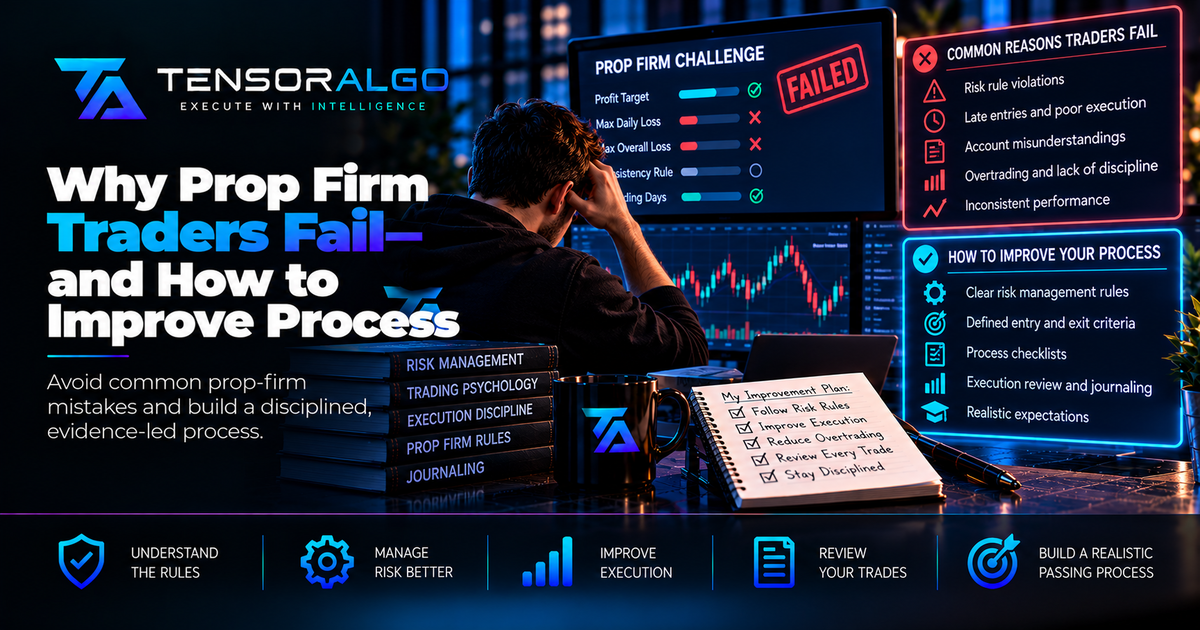
Why Prop Firm Traders Fail—and How to Improve Process
A trader can correctly identify several market moves and still violate an evaluation rule. Another trader can survive one difficult day but exhaust a drawdown allowance by increasing size after losses. The chart strategy may receive all the attention while the actual evaluation depends on risk, timing, discipline and the firm's contract terms.
There is no one verified failure rate that applies to every prop-firm business, product and cohort. Nor are all funded accounts economically or operationally identical. Any serious discussion should avoid pretending there is a universal pass-rate statistic.
What we can examine is how ordinary process mistakes interact with account constraints. That distinction can help developing futures traders approach evaluations as a structured risk-management exercise rather than a sprint toward an advertised payout.
Know Which Type of Account You Are Using
The term "prop firm" covers different business and contractual models. Some evaluation programs use simulated environments or simulated funding; others may connect to distinct live arrangements under specific conditions.
Read the actual agreement rather than inferring that the word funded always means the same as a personal brokerage account. Understand the platform, applicable market-data rules, financial obligations, withdrawal terms and whether execution outcomes are simulated.
Do not present a successful simulated evaluation as an independently confirmed exchange execution record. The NFA guidance on hypothetical results discusses important limitations of hypothetical performance.
The Prop Trading Explained guide provides introductory context, but the exact operator agreement remains authoritative for a particular account.
The Evaluation Rulebook Is Part of Your Trading Strategy
A useful strategy plan needs more than a chart trigger. It must reflect what the particular program permits: risk thresholds, contracts, position limits, trading windows, news restrictions where applicable, prohibited behavior and any relevant consistency requirements.
Some programs use static drawdown definitions; others use trailing or different realized/unrealized calculations. Do not substitute a generic internet explanation for your exact current terms.
Before entering any trade, identify which rules could be breached by a normal market move, an overnight position or a slippage event. Keep a written rule sheet with the relevant source and date.
A trader who doesn't know the contract terms cannot reliably assess whether an otherwise valid market setup is permissible.
Why the Profit Target Can Distort Decisions
An evaluation may have an advertised target that becomes psychologically dominant. A trader close to that level may chase marginal opportunities or increase quantity to "finish" the challenge.
Neither behavior proves the strategy improved. It changes the risk profile and often contaminates the trading sample. The right comparison is not how fast one can reach a target in a lucky run, but whether the decisions follow a defensible process with acceptable downside.
Treat the target as an administrative condition, not as a justification to trade outside your setup. A no-trade day can be entirely compatible with a well-run evaluation even when the target has not yet been reached.
Your process should remain the same during quiet and busy sessions.
Drawdown Rules Deserve Their Own Risk Budget
A drawdown limit is not automatically the same as the displayed account's headline balance. The amount of permissible loss can depend on the firm's definitions, accounting basis and timing.
Build your planned risk around the applicable rulebook, not around a generic fixed percentage. A sequence of otherwise valid losing trades can still push an evaluation beyond its limit.
For illustration, if a hypothetical account has a remaining permissible loss budget of $600, a $250 planned loss creates a very different exposure than a $50 planned loss. Those are arithmetic examples, not recommended quantities or a firm's actual rules.
Predefine per-trade and day limits below the point where a normal single mistake creates an immediate rule violation. Review exposure after each confirmed exit or account-state change.
Avoid Increasing Size to Recover a Loss
A common temptation after two losses is to double contracts on the next setup. This shifts the strategy's risk distribution without improving the underlying entry qualification.
Even if the next trade wins, the decision may have exposed the account to a larger-than-planned setback. A fortunate recovery should not be counted as proof that oversizing is a useful evaluation technique.
CME's risk-management lesson emphasizes maximum trade loss, daily loss, leverage and total exposure. Build those boundaries into your own plan before the session begins.
If quantity must change due to a different stop distance, use a consistent calculation rather than emotions or proximity to a challenge target.
A Stop-Loss Is Not a Promise About Maximum Loss
Futures prices can move quickly, and a protective order may not fill at the exact planned level. Slippage, market gaps, exchange conditions and order behavior can alter realized loss.
This matters more when risk budgets are tight. An apparently acceptable quantity under an ideal stop may produce an account rule problem during a volatile event.
Study the program's position and risk treatment, supported order types and market restrictions. Avoid trading through conditions where your execution assumptions become especially fragile if your strategy cannot handle them.
The CFTC's futures risk overview makes clear that these products carry substantial potential losses. Treat costs and adverse fills as real concerns, not rare footnotes.
Distinguish a Valid Setup From a Trade You Want to Take
A trader may see a familiar price pattern after a series of losses and mentally reduce the required confirmation. The opportunity then becomes attractive because the trader wants a result, not because the original plan qualifies.
Create an exact list of market conditions, entry triggers, invalidation and time windows. If the setup fails a mandatory condition, it should be counted as rejected, not entered and then justified after the fact.
The Rule-Based Trading guide provides a framework for making these conditions explicit. Rules can contain discretion, but that discretion should still be bounded and reviewable.
A narrow set of genuinely qualified setups often provides clearer data than frequent attempts to force action under evaluation pressure.
Missing a Setup Is Better Than Chasing a Poor Entry
A valid signal may appear while you are distracted, the chart is not open or the order platform is delayed. The missed opportunity can feel costly when price continues in the predicted direction.
But entering late changes the remaining risk/reward and can push the stop outside your intended budget. A missed trade is a recordable event; a late chase can become a large financial risk.
Set an expiration condition based on time, price deviation or minimum remaining reward-to-risk. If it expires, record the missed candidate and move on.
Use the Forward Testing Guide to measure real-time recognition of setups rather than only finding them on historical charts.
Know the Contract's Dollar Risk
A fixed number of futures contracts is not a fixed risk amount when stop distance varies. The financial exposure depends on the instrument's contract specification, intended stop distance, fees and execution uncertainty.
Work through the calculation before entering. If your planned stop widens from one setup to another, the quantity compatible with a given risk budget may need to decrease.
Check the Position Sizing Calculator Guide for the basic relationship. Do not blindly borrow another creator's contract count, especially when their account constraints differ.
Correct arithmetic does not guarantee that a stop will fill at the planned price. Your evaluation plan should include a reasonable buffer for uncertainty rather than relying on ideal fills.
Build a Daily Preflight Routine
Before the session, verify which account you are in, the active futures contract, market-data status, platform connection, allowed instruments and any current risk restrictions.
Review scheduled market events, maximum trade/day exposure, whether existing orders remain active, and whether the evaluation has any unique overnight or session constraints. Confirm the rules from the operator when uncertain.
The purpose is not to create an elaborate ceremony. It is to prevent avoidable operational mistakes such as trading the wrong contract or leaving an old order working.
If critical information is unavailable, abstain until the account and market state can be confirmed. "I was not sure" should not become a reason to guess with a restricted account.
Journal Valid Losses and Rule Violations Separately
A compliant stop-out is not the same type of problem as an oversized revenge trade. Both can reduce account equity, but only one clearly represents a departure from the original strategy.
Capture setup eligibility, planned and actual entry, quantity, stop, exit, cost and any deliberate override. Log missed valid setups and skipped trades too, or you will underestimate how often your process broke down.
The Trading Journal Guide provides a useful structure. A clean execution audit can show whether the method itself lacks edge or whether implementation errors dominate.
Do not exclude losing rule violations from your financial history simply because they "weren't part of the strategy." Keep financial truth and strategy-sample classification separately.
How to Measure Progress Without a Payout
A trader can improve process discipline before producing a positive financial result. Examples include fewer unplanned entries, lower average risk deviation, complete trade records, reliable no-trade decisions and better adherence to market-session rules.
These are not guarantees that the strategy will eventually make money. They are signs that the process is becoming easier to evaluate.
Track a small weekly scorecard: valid candidates, compliant trades, skipped candidates, rule violations, incomplete records and realized costs where authoritative data exist. Compare the result with your predefined strategy version.
The How to Pass a Prop Firm Challenge guide covers the broader evaluation context without replacing operator-specific terms.
Build a Session Stop Rule Before It Is Needed
A daily loss or attempt limit is most useful when it is defined before the first losing trade. If you improvise the limit during drawdown, the decision may reflect immediate frustration rather than a tested policy.
Consider maximum daily risk, number of attempts, consecutive-loss response, technical incident handling and what to do if account state is uncertain. Make the policy consistent with the exact firm's restrictions.
Leaving a market with unused time can be a successful process decision. It protects the remaining account risk budget for opportunities that actually qualify later.
This is especially important in futures where a few fast decisions can change exposure quickly.
Do Not Assume Evaluation Results Predict Live Results
A simulated environment may model fills, fees or market data differently from an actual live account. Even in similar conditions, human behavior can change when personal financial stakes change.
The NFA's hypothetical-results guidance highlights limitations involving liquidity, slippage and adherence under financial pressure. That principle applies whenever simulated outcomes are presented as if they establish real execution performance.
When reviewing a challenge, distinguish the evaluation's reported score from broker-verified trading results. The former may be important under a firm's terms; the latter requires independent evidence.
Avoid marketing a challenge pass as proof that a strategy will generate future income for every participant.
How AI Monitoring Can Support the Evaluation Process
An assistant can help watch a rule-based setup and organize relevant context, reducing manual scanning. It might highlight an eligible candidate and make the planned entry, stop and no-trade reasons visible.
However, account limits and execution status should not depend on the model's narrative. Verify the firm's actual account state, trading permissions, data freshness and supported execution source.
TensorAlgo users can structure their own approach with Playbooks. The first Playbook guide describes the creation workflow. The public marketplace is a catalogue for discovering, renting, or buying other users' eligible Playbooks, not a substitute for knowing your evaluation rules.
Software may reduce friction; it does not ensure an evaluation pass or profitable trading.
A Two-Week Process Test
For the next ten trading sessions, choose a single strategy version and fixed evaluation-compliant risk policy. Use simulated practice where appropriate, and never exceed actual program restrictions.
Record each qualified candidate with a timestamp, including missed or expired opportunities. Separate compliant losses from risk violations. Note why any proposed trade was skipped and whether any order status was uncertain.
At the end, ask what actually failed: was the strategy weak net of costs, were entries late, did sizing vary, or were program rules misunderstood? Fix the most serious measurable problem first.
Ten sessions may reveal workflow weaknesses but cannot prove durable positive expectancy. Continue validation across suitable conditions before increasing exposure.
Frequently Asked Questions
Why do prop traders fail challenges?
There is no single verified explanation across every provider. Rule violations, risk exposure, weak strategy economics and operational mistakes can all matter.
Should I trade more near the evaluation profit target?
Not simply because of the target. Only take opportunities that qualify under your documented plan and the provider's current rules.
Are funded accounts always live brokerage accounts?
No. Product models differ. Read the specific contract and verify which activities are simulated versus independently executed.
Can an AI assistant guarantee a pass?
No. It may support monitoring or review, but cannot remove market uncertainty or all user and technical error.
Is passing an evaluation the same as having proven a strategy?
No. A short sample under particular conditions is not proof of future profitability.
An Illustrative Decision Under a Trailing Drawdown
Consider a hypothetical evaluation in which the allowable loss threshold changes according to an operator-defined trailing calculation. The trader sees a technically valid long after a volatile opening move. The setup's intended stop is farther away than normal.
A rushed decision might use the same number of contracts as a tighter-stop setup. That could increase the planned dollar loss and expose the evaluation to its threshold even when the chart method itself remains valid.
A better process checks the current account threshold against the operator's authoritative value, reviews open positions and pending orders, calculates intended loss under the present stop distance, and checks whether the remaining room to target justifies that risk after costs.
If the result is unacceptable, the correct action may be smaller permitted exposure or no trade. Importantly, the trader should not modify the operator's drawdown calculation from memory or assume a rule found on social media is current. Different programs calculate limits differently.
After the session, record the candidate and why it was rejected. This is not a "missed winner" just because price later moved favorably. It is an example of a planned account constraint taking priority over a market idea.
Final Takeaway
A prop-firm evaluation tests more than whether you can recognize a chart pattern. Risk rules, strategy clarity, execution timing, account restrictions and truthful records all matter.
Understand the exact program before trading. Use predefined loss and exposure limits, accept missed opportunities, review the difference between valid losses and rule violations, and keep simulation results separate from verified live execution.
That process cannot guarantee a funded account. It can make your decisions more measurable and reduce avoidable mistakes that have nothing to do with predicting the next candle.