

Why Trading Communities Need Structure
A trading Discord can become a flood of charts, signals, and unverified claims. Learn how clear roles, Playbooks, moderation, onboarding, and educational reviews create a more useful trading community.
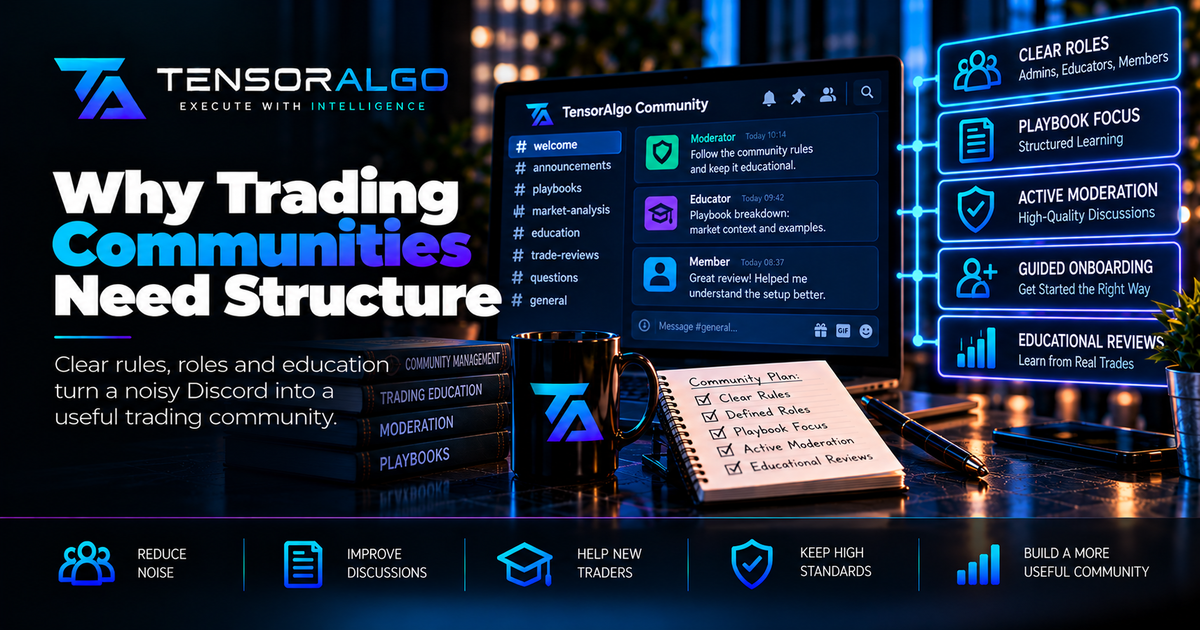
Why Trading Communities Need Structure
A Discord server starts with a few enthusiastic traders sharing charts. A year later, it may contain hundreds of screenshots, fragmented conversations, duplicate questions, alerts, anonymous claims and members who cannot tell which posts are official.
More messages do not automatically create more learning. In trading, disorganized communication can also amplify urgency: a member sees "LONG NOW" without knowing the source, risk, account size, time delay or whether the sender actually took the trade.
Structure means clear purpose, roles, repeatable educational resources, standards for evidence and boundaries around financial claims. It is not about turning a friendly community into bureaucracy. It is about making the space more useful—and safer to navigate.
Define What the Community Is For
Some communities primarily teach futures fundamentals. Others discuss market context, host peer strategy reviews, support software users or provide access to creator content. Each purpose suggests different channels and moderator responsibilities.
Write a short description of what members can expect: educational discussions, documented setups, scheduled workshops, feedback, product support and any restrictions. State what is explicitly not promised.
A community focused on learning should not quietly transform into a paid trade-call service without explaining the change. Its marketing, actual behavior and access terms should agree.
This first step prevents channel proliferation and gives moderators a reference point when an activity falls outside the community's role.
Make Onboarding a Learning Path
A wall of channels is not a curriculum. New members should see a starting point, the required background, community rules and the first practical task.
For a developing futures audience, an onboarding path might cover contracts and leverage, a documented strategy checklist, safe chart-sharing etiquette and a journal template. Students can then join deeper discussions with shared definitions.
Link to the Futures Trading Glossary when technical terminology needs explanation. The objective is not to overwhelm newcomers with every available resource but to help them find the right next step.
Useful onboarding also reduces repetitive direct messages to the creator.
Separate Official Guidance from Member Opinion
A market comment written by a moderator, a speculative post from a member and a versioned educational lesson carry different levels of authority.
Use clear categories or labeling conventions: official lesson, community discussion, hypothetical example, platform notice and verified correction. Do not style every message as if it is a recommended trade.
If the community provides software alerts, identify whether they are algorithmic observations, a creator's personal commentary or an order that was actually executed. The difference matters to anyone reading after the moment has passed.
The Truth About Trading Signals explains why an alert is not a substitute for independent understanding of market and execution risk.
Stop the Screenshot Feedback Loop
A chart screenshot without a time, instrument, strategy or entry condition often produces debate rather than insight. Members then respond with their own screenshots, and the discussion grows without resolving what happened.
Provide a compact post format: contract and session, market context, observed condition, timestamp, hypothesis, invalidation, uncertainty and a specific question. For historical examples, disclose whether the outcome was already known when the screenshot was prepared.
This does not require a complex form for casual discussion. A pinned template can improve substantive analysis without discouraging participation.
Over time the archive becomes searchable evidence about how rules are applied, not merely a collection of memorable wins.
Build Around Playbooks Instead of Personalities
A creator may be admired for recognizing market patterns. But a community that depends entirely on one person's live reactions can struggle when the creator is offline.
A structured Playbook gives members a common language for context, trigger, risk, and no-trade rules. Members can discuss whether the documented condition qualified rather than asking the creator to make every call.
The Playbook concept guide explains the framework. For a member creating their own strategy, the first Playbook guide describes that process.
Documented rules do not guarantee identical interpretations or results, but they give discussion a stable reference.
Create a No-Trade Culture
A trading community may unconsciously reward constant action. When only active entries attract attention, members may feel they failed if they did not trade.
Make valid abstention visible. Discuss days when the required setup never appeared, when price had already traveled too far or when daily risk limits prohibited more exposure.
A member who says "the conditions did not qualify" should not be pressured to produce a trade idea anyway. Similarly, it should be acceptable to say that the data were insufficient to judge.
Teaching no-trade criteria can reduce the temptation to treat every screenshot as an opportunity.
Teach Risk Before Results
Trading involves the possibility of substantial loss. The CFTC's Futures Market Basics describes the complexity and risks of futures trading.
A community should not encourage members to copy position sizes from public accounts or compare dollar gains without context. A move that represents tolerable planned risk to one trader may be inappropriate for another.
Encourage discussions in terms of invalidation, contract specifications, risk per position and realistic costs. The Risk Management Guide provides a useful reference.
If a member posts an outcome, distinguish net realized result from estimated or hypothetical performance. Do not require people to disclose private account details merely to participate.
Moderation Is More Than Removing Spam
Practical moderation can address impersonation, unauthorized solicitation, payment requests, harassment, deceptive performance claims, leaked personal details and repetitive off-topic promotion.
Assign responsibilities and a route for escalating concerns. A moderator should know when to remove a suspicious message, when to warn the community, and when a concern needs creator or platform review.
The SEC's social-media stock-tip scam alert highlights group-based investment scams, impersonation and unrealistic return promises. A trading server should not assume every contact request is harmless.
Treat the protections as ongoing operations rather than one-time rules at signup.
Be Clear About Sponsorships and Affiliates
A community owner may promote tools, platforms or creator partnerships. Material commercial relationships can affect how followers interpret those recommendations.
The FTC's influencer disclosure guidance explains the importance of clear, proximate disclosure for relevant endorsements. Do not assume a disclosure hidden in the channel description reaches everyone who sees a recommendation.
Separate educational advice about choosing a tool from claims motivated by commission. Describe current capabilities accurately and avoid guarantees of financial results.
Transparent incentives give members information they need to evaluate an endorsement.
Build an Archive That Remains Useful
Live conversations disappear quickly beneath newer messages. Important explanations should become organized educational resources: pinned summaries, tutorials, example collections, frequently asked questions and recorded sessions.
Version the material. If a Playbook changes, note which examples belong to the old version. If a market data issue is discovered, correct the record without pretending the original explanation never happened.
A searchable knowledge base helps learners understand recurring questions and reduces the burden of repeating the same answer personally.
An archive is especially valuable for members in different time zones who cannot attend every real-time session.
Feedback Should Focus on Reasoning
If every discussion revolves around whether the trade won, learners may reward luck and retrospectively change rules. A better review asks what was visible at the decision time.
Did the defined setup qualify? Was risk calculated correctly? What evidence would have invalidated the hypothesis? Was the trade taken inside the permitted window? If skipped, was that consistent with the plan?
The Trading Journal Guide can help formalize planned versus actual fields. Encourage participants to present compliant losses and invalidated ideas alongside winners.
This develops a culture of process review rather than performance theater.
Distinguish Community Analytics from Financial Proof
Community engagement metrics may include event attendance, member retention, support response time and lesson completion. These describe the service, not its members' trading profitability.
Strategy studies require different evidence: consistent rule definitions, sufficient decisions, transaction costs and clearly labeled simulations versus actual fills. Do not use one member's screenshot as proof that the entire group follows a profitable program.
If you publish aggregate data, define the population and disclose missing records. Voluntary submissions are subject to selection bias, particularly if people are more comfortable posting winning trades.
A well-run community can be educationally valuable even if members have widely varying trading outcomes.
Don't Overpromise Mentoring Capacity
Creators often invite members to ask questions in direct messages. As membership grows, this can create overwhelming, uneven expectations.
Define office hours, support channels, eligibility for individual feedback and the kinds of questions the team can answer. Use group sessions for recurring educational topics and a knowledge base for repeat technical issues.
The goal is to help many learners without forcing the creator to monitor every trade personally. A predictable service schedule is often more useful than intermittent bursts of attention.
Do not imply individualized financial recommendations are automatically appropriate just because they appear inside an educational server.
Keep the Product and the Community Distinct
The community can support an educational course or software offering, but it should not obscure what subscribers actually bought.
Explain which features and learning materials are included, which require separate purchases or subscriptions, and what happens when access expires. Platform-specific products and creator community memberships can have different terms.
TensorAlgo supports user-defined Playbooks and a public marketplace where users discover, rent, or buy eligible Playbooks from other creators. The marketplace is not the location for creating a member's own Playbook.
Check the Support Center for current account requirements rather than making assumptions about every member's access.
A Simple Community Structure
Start with a welcome channel, community rules, a small number of topic-specific discussion areas, an announcements channel and a curated educational library. Add a review submission space with example formats if group feedback is part of the offering.
Avoid creating ten competing alerts channels before you know what each one is for. Use consistent names, visible moderators and one authoritative location for product changes.
For a member asking a question, the ideal path is obvious: read the relevant guide, post in the correct place, receive grounded feedback and find the answer again later.
Structure should make the community easier to use, not harder to navigate.
How to Evaluate Whether the Structure Works
Measure how long new members need to find the first lesson, which questions recur, whether support issues receive answers and how often the same safety warning must be repeated.
Invite feedback about which channels are useful and which create noise. Review incidents, misinformation corrections and unresolved questions. Consider reducing channels when the system becomes too complicated.
Do not declare success based only on message volume. A quieter community where members complete exercises and understand risk may be a better educational outcome.
Revisit structure periodically as the audience and products change. Governance is a routine maintenance task, not a one-time redesign.
Frequently Asked Questions
Do I need separate channels for every strategy?
Not automatically. Start with a few clear categories and expand only when there is enough consistent discussion to justify it.
Should members share every live trade?
That can encourage copying and undue urgency. Educational examples and clearly labeled hypothetical discussion may be more suitable for some groups.
Can community structure improve profitability?
It may help learning and process discipline, but there is no guarantee that a structured community produces profitable traders.
Are moderators responsible for verifying all market opinions?
Only claim a review process that actually exists. Label official content separately and keep escalation channels for misleading or harmful material.
Can a community replace a trading journal?
No. Discussion can support learning, but personal risk, actual order records and specific rule adherence require trustworthy individual evidence.
Case Study: A Confusing Alert Channel
Imagine a hypothetical community where three moderators share market observations. One posts a potential short at resistance, another posts a screenshot from five minutes earlier showing bullish momentum, and a third shares a chart of a related instrument without explaining the contract. Members interpret these messages as competing instructions.
The problem is not that every observation is necessarily incorrect. The community has failed to distinguish ideas, confirmed setup conditions and actual trade decisions. An inexperienced reader might react to whichever message looks most confident.
A better structure uses a single strategy identifier and status. A candidate might be labeled "watching," followed by "waiting for trigger," "qualified" or "expired." The post would include source timestamp, instrument, rule definition, invalidation and whether the creator is presenting an educational example or discussing an actual position. If no fill is confirmed, it should not appear in a realized performance summary.
Moderators can then direct questions to the relevant versioned Playbook rather than adjudicating conflicting opinions through authority or popularity. A correction should identify what was wrong—such as an outdated price or wrong session profile—and link to the revised explanation.
This approach does not require members to trade a particular strategy, and it cannot guarantee profitable decisions. It helps people understand exactly what a message means and reduces the opportunity to mistake commentary for an instruction.
A Weekly Governance Review for Creators
Once a week, review a small sample of official posts and member questions. Check whether they used the correct instrument, clear timing, current references and the appropriate education-versus-signal label. Identify posts that created avoidable confusion and update onboarding instructions if the same misunderstanding repeats.
Also check whether commercial recommendations included appropriate disclosures, whether suspicious direct-message solicitations were addressed, and whether support requests received accurate answers. Repeated safety incidents should prompt practical moderation changes, not only a reminder to "be careful."
Ask one additional question: what could members learn from the week's discussions without being online when the event occurred? If the answer is little, turn the best explanations into a concise permanent guide.
Tracking these process measures does not establish trading returns. It does indicate whether the community is becoming easier to understand, safer to navigate and more useful as a learning resource.
Final Takeaway
Trading communities need structure because trading discussions mix education, speculation, financial risk and social influence. Without clear boundaries, members can struggle to distinguish an official lesson from a stranger's unverified trade.
Begin with a shared purpose, onboarding, recognizable Playbook rules, honest performance labels, moderation, transparent incentives and a practical knowledge base.
The objective is not more messages or more trades. It is a community where people can find reliable context, ask better questions and learn to make their own decisions under uncertainty.