

GEX and OI overview
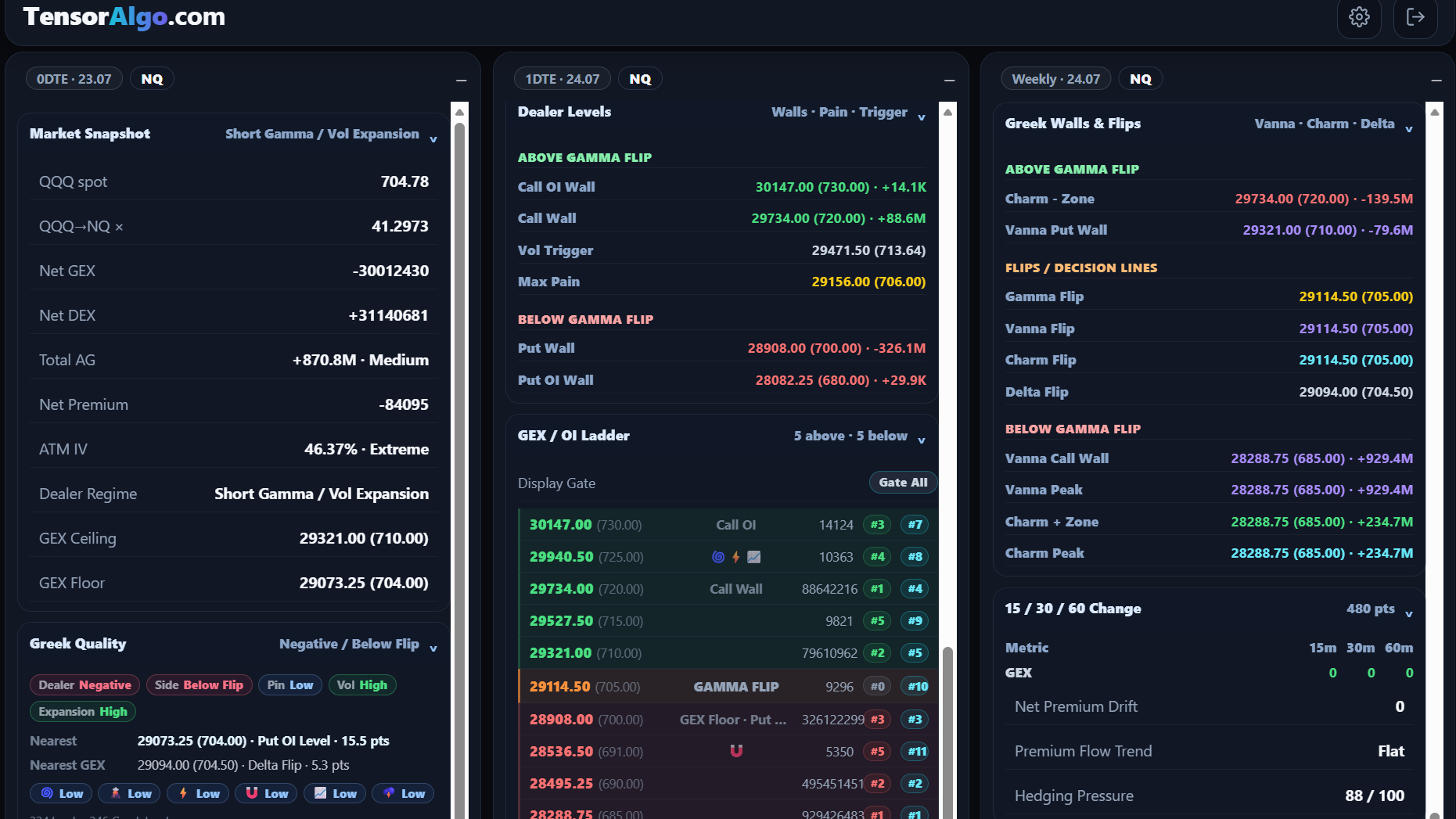
The GEX / OI card provides options-derived market context for supported futures families.
TensorAlgo maps the relevant options market to its related futures instrument:
- QQQ to NQ;
- SPY to ES;
- GLD to GC;
- SLV to SI.
The card is designed to provide context around positioning, concentration, volatility, and nearby reference levels. It should not be treated as a guaranteed trading signal.
Main metrics
Depending on the selected instrument and available data, the card can include:
- Max Pain — an options-derived reference level based on the selected expiry;
- Vol Trigger — a volatility-regime reference level;
- Net DEX — signed delta exposure;
- Total AG — total absolute gamma;
- ATM IV — at-the-money implied volatility;
- Dealer Regime — the current options-derived regime classification;
- Gamma Flip — the level where the gamma profile changes sign;
- Call Wall and Put Wall — concentrated call-side and put-side reference levels.
The card can also show the nearest important level above and below the current market.
Level rankings
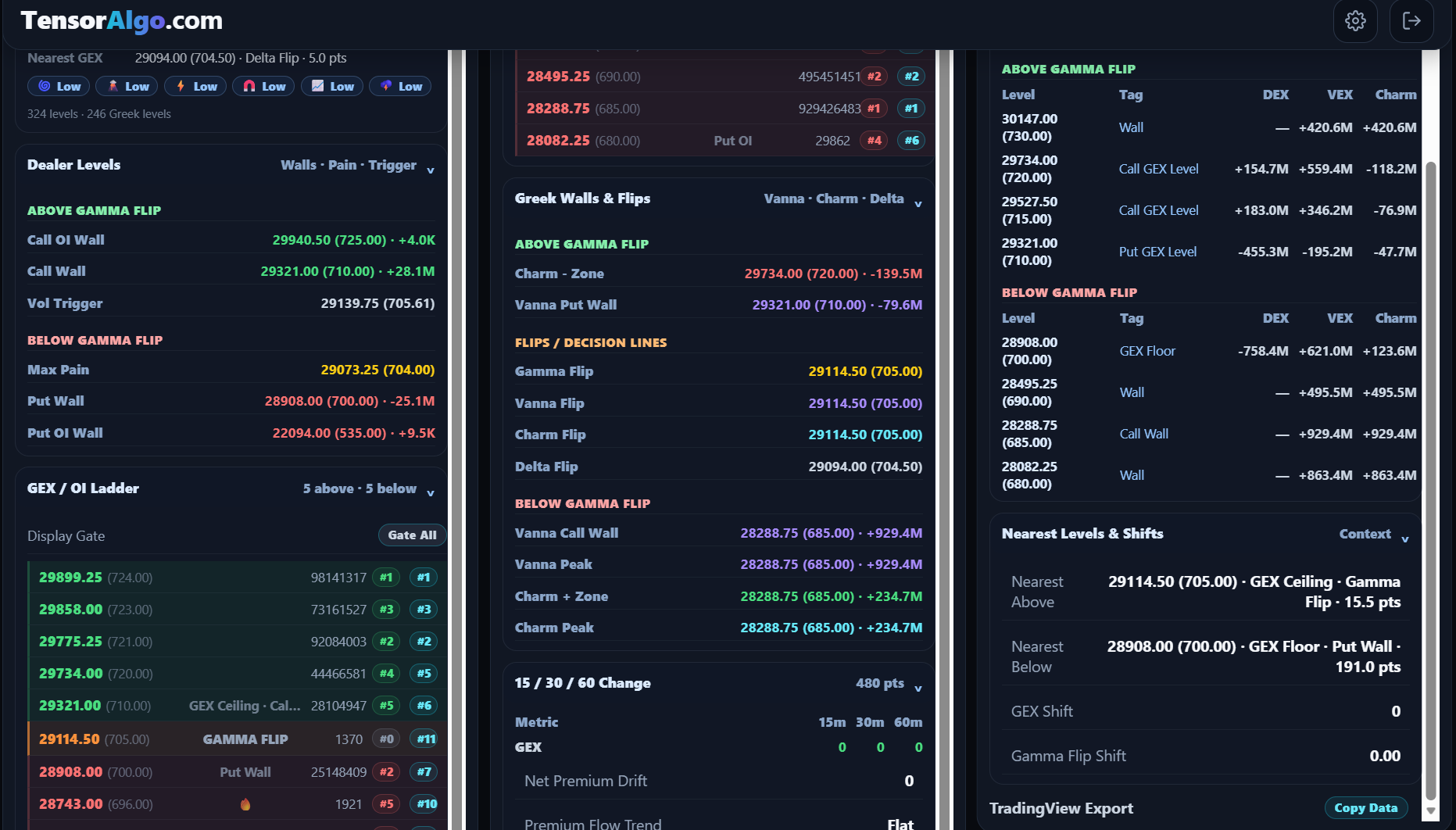
TensorAlgo can rank and display:
- call Gamma levels;
- put Gamma levels;
- call open-interest levels;
- put open-interest levels;
- combined important levels.
Rankings help identify where options positioning is concentrated. They do not predict that price must reverse, stop, or accelerate at a level.
Gamma measurements
Do not treat every Gamma value as the same measurement.
TensorAlgo can distinguish between:
- Gamma Sensitivity Profile — average call and put raw Gamma per strike;
- Signed GEX Exposure — call GEX plus put GEX at the strike;
- Total Absolute Gamma — the absolute aggregate used as a dealer-table metric.
Expiry context
GEX and OI values depend on the selected expiry or expiry mode.
Always review the expiry information before comparing levels across different cards, sessions, or reports.
How to use the information
Use GEX / OI as one part of a wider process that can include:
- Playbook rules;
- current price structure;
- session context;
- liquidity and volume;
- trade-management rules;
- the user's own risk controls.
Options-derived levels and historical behavior do not guarantee future performance.